Resume drafts Unsaved story and dashboard drafts
Comment drafts Unsaved comment drafts
Overview

PSP initially diagnosed as FND

Gender: Female
This case concerns a 62-year-old woman initially diagnosed with functional neurological disorder (FND), whose diagnosis was revised to progressive supranuclear palsy three years after symptom onset. Although FND is often presented as a diagnosis that can be made with considerable confidence, this case demonstrates how such confidence may lead to premature diagnostic closure. Progressive symptoms continued to be interpreted through an FND framework until further deterioration, repeated neurological assessment, and serial neuroimaging revealed an underlying neurodegenerative disorder. The subsequent claim that a “functional overlay” probably remained is difficult to verify and appears to preserve part of the original diagnosis even after it was substantially undermined. The case therefore raises broader questions about the reliability and falsifiability of FND diagnoses, as well as the risk of diagnostic overshadowing when progressive symptoms are attributed to FND.

Based on https://pmc.ncbi.nlm.nih.gov/articles/PMC8060990/

Symptoms

Progressive dysphonia Aphonia Delayed speech initiation Falls Difficulty keeping eyes open Eyelid-opening apraxia Blepharospasm Bradykinesia Rigidity Right foot dystonia Mild vertical gaze limitation Hypometric vertical saccades Difficulty with handwriting Widespread pain Loss of independence Mild cognitive impairment (MoCA 22/30)

Family history

  • Mother had a brain tumour in her 60s

Clinical observations

Hypokinetic laryngeal movements
Apraxia of eyelid opening
Blepharospasm
Mild vertical gaze limitation
Hypometric vertical saccades
Frontalis overactivity
Bilateral bradykinesia
Right-sided rigidity
Right foot dystonia
Mild cognitive impairment (MoCA 22/30)

Timeline
4 events
2017-01 Clinical course

Activity for 2017-01

1 event, 0 medicines, 0 lab results, 1 scan
Events
Clinical course Progressive voice and motor symptoms begin
Scans
2017-01-01
1 item
T2-weighted brain MRI reported as normal, with no abnormalities identified.
Series 1
2018-01 Diagnostic course

Activity for 2018-01

1 event, 0 medicines, 0 lab results, 0 scans
Events
Diagnostic course Functional voice disorder diagnosed
2020-01 Diagnostic course

Activity for 2020-01

1 event, 0 medicines, 0 lab results, 1 scan
Events
Diagnostic course Diagnosis revised to atypical akinetic-rigid syndrome
Scans
2020-01-01
1 item
Brain MRI showed normal midbrain and pontine volumes, with susceptibility-weighted hypointensity in the substantia nigra, red nuclei and bilateral globus pallidus, interpreted as suggestive of iron deposition.
Series 2
2020-02 Diagnostic course

Activity for 2020-02

1 event, 0 medicines, 0 lab results, 1 scan
Events
Diagnostic course Progressive supranuclear palsy diagnosed
Scans
2020-02-01
1 item
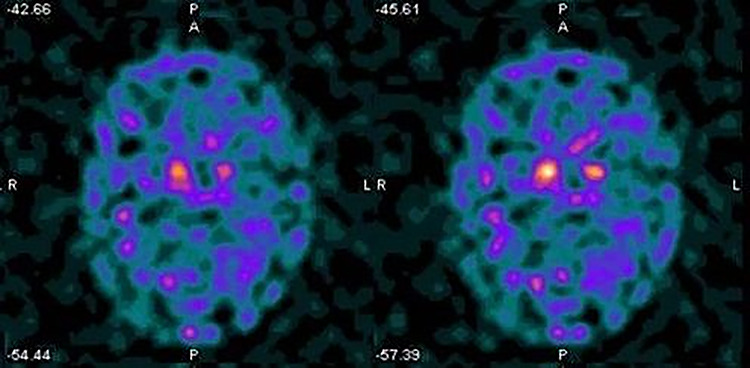
DaTscan showed marked bilateral reduction in [123I]FPCIT tracer binding.
Series 3
Medicine
0 months
Month Medicines
No medication records found.
Lab Results
3 sections

Full blood count

4 items
Test / Reference Readings Range graph
Haemoglobin
Haemoglobin is the oxygen-carrying protein in red blood cells and is used to assess anaemia or increased red-cell concentration.
Lower: 115 Upper: 155 Unit: g/L
Lower: Low haemoglobin is anaemia and may be due to iron deficiency, B12 or folate deficiency, blood loss, inflammation, kidney disease, haemolysis, or marrow disorders.
Upper: High haemoglobin may be seen with dehydration, smoking, lung or heart disease, high altitude, testosterone use, sleep apnoea, or polycythaemia.
No numeric scale available.
Haematocrit
Lower: 0.33 Upper: 0.45 Unit: L/L
No numeric scale available.
Mean corpuscular haemoglobin concentration
Lower: 320 Upper: 360 Unit: g/L
No numeric scale available.
Mean corpuscular volume
Lower: 80 Upper: 99 Unit: fL
No numeric scale available.

Renal function

2 items
Test / Reference Readings Range graph
eGFR
Unit: mL/min
No numeric scale available.
Creatinine
Creatinine is a waste product from muscle metabolism filtered by the kidneys and commonly used with eGFR to assess kidney function.
Lower: 49 Upper: 92 Unit: µmol/L
Lower: Low creatinine may reflect low muscle mass, pregnancy, low meat intake, or dilution and is often not harmful on its own.
Upper: High creatinine may suggest reduced kidney filtration, dehydration, urinary obstruction, high muscle breakdown, medicines, or high meat intake.
No numeric scale available.

Iron studies

1 item
Test / Reference Readings Range graph
Ferritin
Ferritin is a protein that stores iron and is commonly used to assess body iron stores.
Lower: 13 Upper: 150 Unit: µg/L
Lower: Low ferritin strongly suggests depleted iron stores and is commonly seen in iron deficiency, with or without anaemia.
Upper: High ferritin may be seen with inflammation, infection, liver disease, metabolic syndrome, kidney disease, malignancy, alcohol use, or iron overload.
No numeric scale available.
Analysis
6 matches

Single readings that fall outside the reference range.

Full blood count
Haematocrit
Lower: 0.33 Upper: 0.45 Unit: L/L
2020-09-22: 0.33
Haemoglobin
Haemoglobin is the oxygen-carrying protein in red blood cells and is used to assess anaemia or increased red-cell concentration.
Lower: 115 Upper: 155 Unit: g/L
2020-09-22: 103
Mean corpuscular haemoglobin concentration
Lower: 320 Upper: 360 Unit: g/L
2020-09-22: 313
Mean corpuscular volume
Lower: 80 Upper: 99 Unit: fL
2020-09-22: 103.1
Iron studies
Ferritin
Ferritin is a protein that stores iron and is commonly used to assess body iron stores.
Lower: 13 Upper: 150 Unit: µg/L
2020-09-22: 306
Renal function
Creatinine
Creatinine is a waste product from muscle metabolism filtered by the kidneys and commonly used with eGFR to assess kidney function.
Lower: 49 Upper: 92 Unit: µmol/L
2020-09-22: 140

Comments

Is this a real case? Published or someone shared their story with you? This is a good example of why patients diagnosed with FND should have longitudinal care with neurology - the standard of care. Vast majority will continue to just have FND but there is a small percentage of people, particularly older adults, who may have a change in clinical presentation requiring diagnostic revision. It’s important to note that these examples are not examples of misdiagnosis. At the time of diagnosis, it sounds like this patient was not presenting with typical signs of PSP. Sometimes neurological diseases need time to progress for the clinical picture to become clear. In these cases, the initial diagnosis of FND isn’t really harmful because there is nothing you can do to slow progression of PSP and FND rehabilitation could still be beneficial. It sounds this her medical team did a good job reassessing her symptoms as they progressed, ordered additional testing that was indicated, and revised the diagnosis that fit the clinical picture. Unfortunately the people who visit this site won’t understand this and will use it as evidence that they were misdiagnosed and have a terminal neurodegenerative disease.

Profile picture
27 Jul 2026 by FndNope Moderator

This dashboard entry is based on a real, published case report: "Revising a diagnosis of functional neurological disorder—a case report".


In this particular case, I agree that the neurologists did their due diligence. They continued following the patient, recognised that the clinical picture was changing, ordered further investigations and revised the diagnosis to progressive supranuclear palsy. They deserve credit for doing precisely what longitudinal neurological care should involve.


That does not, however, make the case irrelevant to a website focused on sceptical examination of FND. The authors themselves state that the FND diagnosis was revised and that diagnostic overshadowing "likely occurred." The case demonstrates both sides of the issue: an early presentation may genuinely be difficult to interpret, while continued reassessment can prevent an FND diagnosis from becoming permanently fixed despite new evidence.


My father used to talk about first-year psychology students who became convinced they had every condition they were studying. It is an old and familiar phenomenon, but nobody suggests that psychology students should therefore be shielded from the literature. The proper response to possible misunderstanding is education and context, not withholding information.


Similarly, the suggestion that visitors to this website "won't understand" the case and will conclude that they have a terminal neurodegenerative disease is speculative and medically paternalistic. It assumes that patients are incapable of engaging responsibly with published evidence and must therefore have information filtered for them.


This is explicitly a website concerned with sceptical examination of FND: its evidence, diagnostic practices, limitations and potential for diagnostic harm. It would be strange to exclude a published case because it could cause someone to question an FND diagnosis. Scepticism does not mean claiming that everyone diagnosed with FND has PSP. It means presenting the evidence, including cases that reveal diagnostic uncertainty, and allowing it to be examined critically.


We also cannot generalise from the diligence shown in this case and assume that every patient receives the same standard of care. We cannot assume that doctors are always correct, always consider every reasonable differential diagnosis or always apply the FND criteria as intended.


In my country, roughly 150 neurologists serve a population of approximately 62 million people. They are overworked, services are understaffed and consultations can become something of a conveyor belt. That is not necessarily the fault of individual neurologists; it is often the unavoidable consequence of a severely constrained healthcare system. Nevertheless, it means that comprehensive investigation and reliable longitudinal follow-up cannot simply be presumed.


Training in FND is also not consistently up to scratch. In our experience, and in reports from many other patients, clinicians who diagnose FND sometimes appear genuinely unfamiliar with the requirement for positive clinical signs. When asked which positive signs supported the diagnosis, some effectively respond, "What positive signs?" We therefore cannot assume that every FND diagnosis was made according to modern standards merely because a neurologist recorded it.


I also disagree that an incorrect initial diagnosis is necessarily harmless simply because PSP has no disease-modifying treatment. Diagnosis affects prognosis, counselling, symptom management, monitoring of risks, access to appropriate services and the patient's ability to plan. The absence of a cure does not make diagnostic delay inconsequential.


The answer is not to treat patients like children who must be protected from medical information. Patients should be empowered to understand what evidence supports their diagnosis, ask which positive signs were demonstrated, recognise meaningful changes in their presentation and request reassessment where appropriate. Patients should be partners in diagnostic safety, not passive recipients expected to accept every clinical conclusion without question.

Leave a comment
Open Discussion

All comments are reviewed before being published. A wide range of opinions is allowed, as long as they are relevant and respectful.

Commenting on
Replying to
Uploading image... 0%