FND: Philosophy Masquerading as Diagnosis - Part 2
 Christoff Trüter
Spousal caregiver
Christoff Trüter
Spousal caregiver
In Part 1, I argued that FND is a speculative label without biomarkers, built on subjective signs and broad, non-specific symptoms, and concluded that it is philosophical in nature, demanding investigative rigour rather than premature certainty. While fMRI findings are sometimes cited as supporting evidence, similar patterns are seen in other conditions, making such results non-specific and incapable of establishing true correlation, particularly given that non-organic causes are assumed from the outset.
In this part, we will take a closer look at the philosophy that shaped FND into the diagnosis we know today.
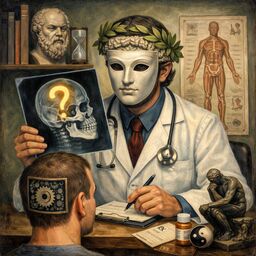
The first thing to note is that FND is a product of medical constructivism (in contrast to medical realism). So if we are to buy into this philosophy, what exactly does that mean?
Let's start with definitions:
-
Realism
Reality exists independently of human perception or beliefs. Facts, objects, and structures have an objective existence, and our knowledge is an attempt to discover them. "The world is what it is, whether we recognise it or not." -
Constructivism
Reality is socially or cognitively constructed. What we know about the world is shaped by culture, language, and human interaction. "Reality is what we make of it through our perceptions and social processes."
Using constructivism in a medical setting is not unique to FND. It has also given rise to psychosomatic illness, somatic symptom disorder, chronic fatigue syndrome,
fibromyalgia, ADHD, and other behavioural health disorders that interpret symptoms through psychological or social factors rather than measurable physiological causes.
One thing I have observed in FND circles is a lack of transparency from doctors around these facts, and possibly even among doctors themselves, about what the diagnosis does and does not mean. This allows an abstract concept to be treated as certainty, giving a false sense of security and creating a potentially dangerous sense of certainty — for example, a doctor telling my wife that he is 99% sure what is wrong with her.
To illustrate how absurd this claim is, I will discuss an article based on a study written by the main proponent of FND, almost a decade before it was officially included in the DSM-5, from BMJ 2002; 325:1449, titled "What should we say to patients with symptoms unexplained by disease? The number needed to offend."
The study examined how patients perceive different diagnostic labels for symptoms unexplained by disease, such as weakness. Labels like "hysterical" were highly offensive, while "functional" was less so, despite doctors fearing it might be pejorative. "Medically unexplained" sounded neutral but carried surprisingly negative connotations. The authors argue that diagnostic labels should be both clinically useful and acceptable to patients, recommending the rehabilitation of "functional" as a patient-friendly and meaningful term for unexplained physical symptoms.
As a realist, I find this proposition utterly insane.
My first reaction was WTF - who are these people? Why are they offended that doctors cannot explain where their symptoms come from?
My second reaction was WTAF - why must we give uncertainty a new name just to avoid offending, while in the process obscuring facts and attaching a prognosis to that name?
Initially, FND was effectively defined in terms of MUS (Medically Unexplained Symptoms), but through diagnostic authority grounded in constructivist philosophy (it is because we say it is), FND came to be presented as distinct from MUS. From a realist perspective, however, the distinction is largely semantic: the symptoms remain medically unexplained because their cause has not been established. The uncertainty has not been eliminated; it has been renamed.
Why can't we simply admit that we do not know why you are presenting with these neurological symptoms, recognising that such symptoms are not always produced in the brain? Instead of applying unnecessary labels, other specialities should be consulted, but not in the usual FND proposed sense, where psychiatrists, psychologists, and therapists are brought in, but in a more focused way. For example, rather than assuming vestibular issues are psychological, involve an Otolaryngologist; instead of assuming a psychiatrist must evaluate eye pain, involve an Ophthalmologist.
There is no need to assume that the answers must be neurological simply because a neurologist feels compelled to provide a diagnosis.
Why must everything be bagged and tagged? Why can’t we simply say, "I know not", and then investigate further instead of forcing a label onto the unknown?
Sure, it would be much cheaper in terms of medical bills to simply accept the label, and everyone involved would sleep better at night, believing that applying this new label somehow transformed unknowns into knowns. Why are we so confident in our ignorance that we assume the unexplained is not dangerous to the patient?
Consider the absurdity: "I am 99% sure you have FND" means "I am 99% sure which consensus-defined label to apply, but 100% sure that I still cannot establish why your symptoms are happening." The certainty belongs to the classification, not to the underlying cause. Constructivism gives the unknown a name; realism recognises that naming it has not explained it.
When it comes to my wife's health, I'm sorry, but I choose to look at actual data. I am not interested in labels propped up by diagnostic authority bias where the confidence of the messenger is mistaken for proof. I choose to live in reality.