Differential Diagnosis: Charcot-Marie-Tooth (CMT)
 Christoff Trüter
Spousal caregiver
Christoff Trüter
Spousal caregiver
Charcot-Marie-Tooth (CMT) is a hereditary (genetic) disorder, not dental related as the name might suggest, that impacts the peripheral nerves, that is motor (movement) and sensory (sensation) nerves in the arms, legs, hands, and feet.
It is named after French neurologists Jean-Martin Charcot and Pierre Marie, and British neurologist Howard Henry Tooth, who first described it in 1886.
This disease typically presents dramatically in childhood or adolescence, so it is rarely considered in the differential diagnosis for functional neurological disorder (FND). However, I am particularly interested in adult-onset cases, especially milder or atypical subtypes, which can be easily overlooked due to initially normal MRI findings and other subtle presentations. Fortunately, we have a supportive neurologist who has collaborated with us and facilitated genetic testing.
The presentation is generally as follows:
- Foot deformities High arches (pes cavus), hammer toes
- Distal muscle wasting Especially in lower legs ("stork leg" appearance)
- Foot drop and frequent tripping/falls
- Loss of reflexes (areflexia)
- Hand weakness and atrophy in later stages
- Sensory loss (especially vibration and proprioception)
The reason I looked into this disease is that our physiotherapist expressed concerns about my wife's peripheral nerves and issues related to her plantar fasciitis, which prompted me to research disorders that might fit that profile.
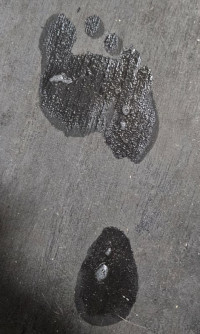
As per CMT presentation, she presents with extremely high arches in her feet (her footprint in the photo on the left), hand weakness, areflexia and sensory loss.
Charcot-Marie-Tooth (CMT) has over 100 known genetic mutations identified so far, grouped into several main types and subtypes:
- CMT1 Demyelinating (autosomal dominant)
- CMT2 Axonal (autosomal dominant)
- CMTX X-linked (mainly CMTX1)
- CMT4 Demyelinating (autosomal recessive)
- CMTDIA/B Intermediate types (mixed features)
Given the demyelination and axonal degeneration, CMT can present with symptoms similar to multiple sclerosis (MS) and other neurological disorders. However, CMT affects the peripheral nervous system (PNS), while MS primarily affects the central nervous system (CNS). Peripheral neuropathy, as seen in CMT, could potentially cause distorted sensory input, leading to a central nervous system reflex that might be misattributed to the standard FND model.
In our country (South Africa), testing primarily focuses on PMP22 gene duplications, as it is the most commonly diagnosed cause of CMT. Fortunately, or unfortunately, the results for the 4 out of over 100 possible genes tested came back inconclusive, which is not enough to confirm or rule out a diagnosis at this stage.
Due to the limitations of this genetic test, our next step is to conduct a nerve conduction study (NCS) to evaluate potential nerve damage. Unfortunately, our local neurologist has halted further investigations based on their Functional Neurological Disorder (FND) diagnosis. As a result, we may need to travel to a larger metropolitan area to consult with our current neurologist for further assistance.
For more information visit the Charcot-Marie-Tooth Association .
Regardless of a possible diagnosis, genetic testing is an additional avenue of investigation to consider when searching for underlying causes.
References
- Integration of Next-Generation Sequencing (NGS): NGS allows for comprehensive analysis of multiple genes simultaneously, enhancing the ability to diagnose complex neurological disorders more efficiently and accurately. Read more