The FND Dualism Debate May Be Starting With the Wrong Question
 FndNope
Moderator
FndNope
Moderator
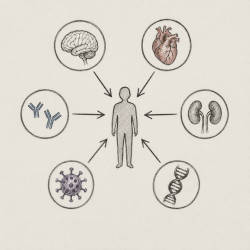
An interesting disagreement has opened up over where Functional Neurological Disorder belongs, and what exactly people mean when they accuse an explanation of being "dualistic". In Functional neurological disorders: misunderstanding "Dualism", Anton Scamvougeras and David Castle argue that contemporary thinking about FND has misunderstood dualism and moved too far away from psychiatric and psychological explanations. Jon Stone responds in Defying dualism in functional neurological disorder … again: response to Scamvougeras and Castle, arguing against making the psychiatric level the preferred explanation.
It is an interesting argument, but after reading both sides I am left wondering whether the argument begins one step too late. Before deciding whether FND is psychiatric, neurological, neuropsychiatric or some combination of these, how certain are we about the thing being classified?
What is the disagreement about dualism?
Scamvougeras and Castle make a fairly straightforward point. Modern psychiatry does not require a belief in a mind floating independently of the physical brain. Fear involves the brain. Depression involves the brain. Psychological processes involve the brain. A psychiatric disorder can therefore be entirely brain-based without becoming a neurological disorder in the ordinary clinical sense. On that basis, they argue that the FND literature has stretched the accusation of "dualism" too far. Distinguishing predominantly psychiatric from predominantly neurological disorders does not require Cartesian mind-body dualism (The idea that the mind and body are fundamentally separate things), because both ultimately involve the same physical organ.
They go considerably further than making a philosophical point about terminology. Their argument places FND firmly towards the psychiatric and psychological end of a neuropsychiatric continuum, and they argue for the continued explanatory and clinical importance of psychiatric and psychological conceptualisations. In broad terms, this looks like movement back towards territory previously occupied by Conversion Disorder. It is not necessarily a return to Freud, repression or the requirement for an identifiable psychological stressor, but psychological and psychiatric processes are once again being given explanatory priority.
Stone does not want to go back there
Stone agrees with Scamvougeras and Castle on more than might initially be obvious. He accepts the need for a biopsychosocial model and acknowledges that some academic and public discussion of FND has minimised psychological factors. Where he parts company with them is their proposal that the psychiatric level provides the best way of understanding FND. Stone argues that this risks making psychiatric factors universally explanatory when the evidence instead supports understanding FND at multiple levels.
He also challenges the boundary Scamvougeras and Castle are trying to preserve between neurological and psychiatric disorders. A distinction based simply on the presence or absence of identifiable pathology becomes difficult to maintain. Conditions such as Parkinson's disease and epilepsy are intrinsically neuropsychiatric, while conditions accepted as neurological, including migraine and Tourette syndrome, may not reveal pathology on standard clinical investigations. Stone consequently raises another interesting question: is the neurologist's role primarily to identify pathological disease, or is it also to diagnose and manage neurological symptoms?
His answer to the broader FND problem is therefore not simply to choose the neurological side instead. A patient can be understood at several levels at once. Altered brain networks and motor control may provide one level of explanation, while attention, expectation, learning, previous experiences, psychological factors and social circumstances may provide others. Stone points to chronic nociplastic pain as an example of how psychiatric and neurobiological perspectives can coexist without requiring one to dominate the other.
This makes the disagreement over "dualism" clearer. Scamvougeras and Castle are effectively saying that calling something predominantly psychiatric is not dualism because psychiatric phenomena already occur in the brain. Stone is saying that privileging the psychiatric level is unnecessary and conceptually unstable when neurological and psychiatric explanations can coexist at different levels.
But this also exposes the question that interests me most. Stone's framework may provide a way of accommodating several possible levels of explanation, but accommodation is not the same thing as demonstration. Saying that FND symptoms can be understood through altered brain networks alongside psychological and social processes still leaves open which mechanisms have actually been established, how specific they are to FND, and whether the patients grouped under FND necessarily share the same underlying process in the first place.
Are we having a Kirk versus Picard debate?
This is where the whole argument begins to remind me slightly of the eternal Star Trek argument over who was the better captain: Kirk or Picard. People can spend hours constructing elaborate arguments. Kirk was instinctive, decisive and willing to break the rules. Picard was diplomatic, cerebral and principled. Entire corners of the internet have probably been sacrificed to this question. I have my own answer, obviously, but the argument works because nobody first has to establish that Kirk and Picard actually exist as distinct characters. That part of the ontology is settled before the comparison begins.
Now imagine having the Kirk-versus-Picard argument while nobody has yet established that there are actually two captains being compared. Perhaps several different characters have been grouped together because they wear similar uniforms, sit in similar chairs and say "Engage" at roughly the appropriate moment. We could still have a remarkably sophisticated argument about which captain is better. We could produce papers about leadership style, compare outcomes and argue about which bridge they belong on. But the sophistication of the debate would not solve the more basic problem that we had skipped.
That is what bothers me about parts of the current FND debate. Scamvougeras and Castle can argue that FND belongs towards psychiatry. Stone can argue that forcing it towards either psychiatry or neurology is unnecessary. These are arguments about how an accepted entity should be explained. But there is a prior epistemic question: what demonstrates that the recurring clinical presentations grouped under FND represent one underlying disorder in the first place?
A phenotype is not automatically a disorder
Recognising a phenotype is not the same thing as establishing its cause. Tremor is a phenotype. Weakness is a phenotype. A particular gait is a phenotype. Similar observable presentations can arise through very different underlying mechanisms. Positive FND signs may help a clinician recognise a particular pattern, but recognising that pattern does not automatically establish that everyone displaying it shares the same underlying disorder or mechanism. The movement may be recognisable while the reason for that movement remains unresolved.
This is the point behind what I have called the Common Phenotypes Hypothesis: FND may, at least in some cases, be a name given to recurring neurological presentations shared by multiple underlying conditions or processes, rather than evidence of a single distinct disorder responsible for producing them. That is a hypothesis, not a conclusion. It does not require claiming that symptoms are unreal, voluntary or insignificant, nor does it require denying that psychological factors, motor learning, attention or altered brain activity may be important in some patients. It simply changes the order of the questions. Before asking what explains FND, we first ask what has actually been established by recognising the phenotype.
Does "brain network dysfunction" get us out of this?
This is also where the modern language of brain networks becomes interesting. Calling FND a disorder of brain-network functioning sounds considerably more neurological than Conversion Disorder, and it can easily be heard by patients and clinicians as a neurological explanation of the condition. But Scamvougeras and Castle's own argument about dualism exposes a difficulty with that interpretation: psychiatric and psychological phenomena are already phenomena of the brain. Fear has a neural implementation. Attention does. Expectation does. Learning does. Depression does. PTSD does. If all of these can legitimately be described in terms of altered brain activity and networks, then "brain-network dysfunction" is not language that belongs uniquely to neurology. It can just as easily describe processes that psychiatry has been studying for decades.
That makes the terminology potentially confusing. "Brain-network dysfunction" sounds biological and neurological, while terms such as fear, expectation, attention, cognitive rigidity, trauma or psychological distress sound psychiatric or psychological. Yet the former may simply be the neural level at which some of the latter are expressed. Unless a specific network abnormality has been demonstrated to be causal and characteristic of FND, moving from psychological language to network language does not necessarily mean that a distinct neurological mechanism has been discovered. The same phenomenon can potentially be described once in psychological vocabulary and again in neuroscientific vocabulary.
The older Conversion Disorder explanation could be expressed, admittedly rather crudely, as psychological processes producing neurological symptoms. A modern account may instead describe psychological, cognitive, biological and other processes interacting with altered brain networks to produce neurological symptoms. There is considerably more neuroscience vocabulary in the second account, and there may well be useful neuroscience behind parts of it. But the important epistemic question remains: which links in that causal chain have actually been demonstrated?
This is why the neurological framing can become difficult to separate from psychiatric framing merely by appealing to brain networks. If psychiatry is already concerned with processes implemented by the brain, demonstrating or hypothesising network involvement does not automatically move a condition from one discipline to the other. Depression does not become a neurological disease simply because functional imaging identifies network differences associated with depression. The same evidential standard has to apply to FND.
There is therefore a risk of mistaking a change in explanatory level for a change in explanation. "Fear and expectation influence symptoms" and "networks involved in threat, prediction and attention show altered activity" may sound like very different claims, but the second does not necessarily provide an independent causal explanation of the first. It may sometimes be describing related phenomena at a different level.
None of this means that network research in FND is meaningless or that a neurological mechanism could not ultimately be demonstrated. The issue is what the existing evidence allows us to claim. If altered network activity is associated with the phenotype but has not been shown to be specific to FND or causally responsible for producing it, then "brain-network dysfunction" cannot by itself carry the explanatory weight of an established mechanism.
This raises an uncomfortable but legitimate question: has the Conversion Disorder model genuinely been replaced by a demonstrated neurological mechanism, or has some of its psychological machinery been reclothed in neurological language?
Ontology, epistemology and values
One way of making sense of the argument is to separate three questions that are easily collapsed into one. The first is ontology: what exactly is FND? Scamvougeras and Castle offer one answer, placing it substantially towards the psychiatric and psychological end of the spectrum. Stone offers a broader account in which psychiatric and neurobiological explanations coexist at different levels. The Common Phenotypes position is deliberately less certain. The phenotype is observable; whether that phenotype identifies one underlying disorder is precisely the part being questioned.
The second question is epistemological: what do we actually know, and what evidence allows us to know it? A positive clinical sign can identify a pattern without identifying its cause. A psychological association can be relevant without demonstrating psychogenic causation. A difference on functional imaging can be genuine without demonstrating that it caused the symptoms. Evidence for a presentation, evidence for a mechanism and evidence for a disease entity are not interchangeable, and moving between those categories requires evidence rather than assumption.
The third question concerns values. Scamvougeras and Castle want to preserve the usefulness of psychiatric and psychological explanation. Stone values an integrated account that does not require one explanatory level to dominate another. My concern lies particularly with epistemic restraint and diagnostic openness: preserving uncertainty where uncertainty remains, especially where treating a presentation as an explained disorder could make clinicians less willing to consider other explanations. These values are not necessarily mutually exclusive. But the usefulness, elegance or therapeutic value of a framework cannot substitute for evidence that its underlying causal claims are correct.
The argument may be starting one step too late
There is therefore something slightly strange about watching FND being pulled between psychiatry and neurology yet again. Scamvougeras and Castle argue that there is nothing philosophically improper about placing it towards psychiatry. Stone argues that neither psychiatry nor neurology needs to win. They can continue that debate, just as Star Trek fans can continue arguing about Kirk and Picard for another sixty years.
But the FND debate has a more fundamental problem than the captain of the Enterprise. Before deciding which explanatory framework best describes FND, we need sufficient epistemic grounds for believing that the thing being explained is a coherent underlying disorder rather than a recurring phenotype potentially produced by heterogeneous mechanisms. If that has not yet been established, then arguing about whether FND is fundamentally psychiatric, neurological or both risks becoming an extraordinarily sophisticated debate built on an assumption that sits largely outside the debate itself.
Before asking whether Kirk or Picard should command the Enterprise, make sure we have established who is actually sitting in the captain's chair.