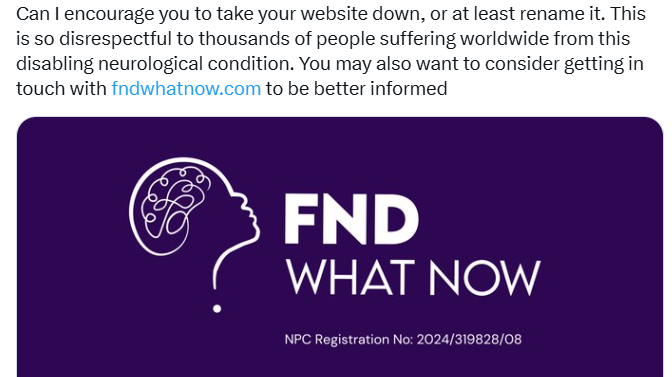
I encourage you to take your website down
 Christoff Trüter
Spousal caregiver
Christoff Trüter
Spousal caregiver
Barely a week after launching this website and I already received my first calls to take it down.
The content on this website revolves around ongoing investigations into my wife's degrading health and reflections on a hypothesis I've been exploring: that Functional Neurological Disorder (FND) may ultimately prove to be a central nervous system reflex to unknown underlying causes, rather than a fully-fledged disorder in itself.
Strangely, some in the FND community deemed this line of reasoning offensive and disrespectful.
Having diverse perspectives isn't necessarily a sign of ignorance; in this context, it's an exercise in critical thinking, saying, "Hey, let's consider different interpretations".
Let me be clear:
I am not denying suffering.
I am not saying symptoms are imaginary.
I am not even saying doctors are wrong.
I suspect that the offended reactions stem, at least in part, from the deep identity and emotional investment many have made in the diagnosis. For some, it provides validation, meaning, and community, things that are often missing from traditional medical experiences. When that narrative is challenged, it can feel deeply personal and even threatening.
This is entirely understandable, especially considering the long history of abuse, dismissal, and stigma attached to diagnoses like hysteria, conversion disorder, and now FND. Many have suffered immensely at the hands of clinicians who misunderstood or minimised their experiences.
But that history, as tragic and important as it is, cannot justify placing FND beyond scrutiny. We cannot afford to turn it into a sacred cow, immune to critique or scientific debate.
The cost of doing so is too high: stagnation, misdiagnosis, and missed opportunities for treatment.
This is exactly why I started this website: because taking offence at difficult questions or alternative interpretations closes diagnostic doors. And when that happens, people suffer. Treatable conditions go undiagnosed, symptoms are dismissed, and preventable harm becomes permanent. The search for truth should never be silenced by discomfort.
My wife and I are not immune to these challenges. The process of seeking answers has been financially and emotionally exhausting. I will continue fighting for her because the risk is not just misdiagnosis, but something worse: developing a kind of Stockholm syndrome toward the medical system, where we accept a label out of fatigue and let a diagnosis become a Trojan horse.
I will never forgive myself if I contribute to closing diagnostic doors for her. That is why I built this site — to challenge assumptions, to keep questioning, and to ensure no one else's path to the truth is blocked by fear, offence or complacency
FND is a diagnosis based on positive clinical signs and exclusion
These details matter greatly. Understanding FND's root cause could lead to better treatments, or even the identification of underlying causes that may currently be going unrecognised.
To question the dominant model of FND is not to invalidate the people who suffer from it. Quite the opposite: it is to say that they deserve more, more clarity, more science, more honesty, and better treatment. Do not protect patients by turning diagnoses into dogma. Protect them by continuing to ask hard questions and by refusing to settle for uncertainty when the stakes are this high.
Below you can find a small sample of documented cases where functional disorders were initially diagnosed but later orchestrated to another condition, with sources for each case.
1. Multiple Sclerosis (MS)
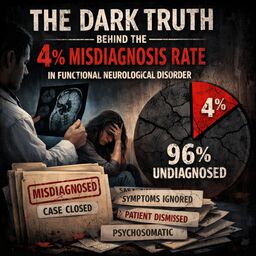
Case Evidence: A systematic review identified MS as a common condition misdiagnosed as FND due to overlapping motor and sensory symptoms. In appraising 1,030 FND patients, 0.4% (4 patients) were later diagnosed with another condition, including one case of MS. Another study of 89 patients with functional limb weakness found one patient whose symptoms were later attributed to MS.
Reason for Misdiagnosis: Normal MRI scans or psychiatric comorbidity can lead to an FND diagnosis when MS is present, as early MS may not show clear lesions.
2. Progressive Supranuclear Palsy (PSP)
Case Report: A 62-year-old woman was diagnosed with a functional voice disorder (FND subtype) based on variable vocal output and normal initial MRI. Three years later, symptoms including falls, aphonia, eyelid apraxia, and blepharospasm led to a revised diagnosis of PSP after MRI showed iron deposition in the substantia nigra.
Reason for Misdiagnosis: Initial normal neuroimaging and variable symptoms suggested FND, but progressive symptoms and specific MRI findings confirmed PSP.
3. Paroxysmal Kinesigenic Dyskinesia (PKD)
Case Report: A 14-year-old male was diagnosed with FND based on suppressible movement symptoms and psychiatric comorbidity. Later evaluation revealed PKD, a rare monogenic movement disorder, as the correct diagnosis.
Reason for Misdiagnosis: Suppressible symptoms and psychiatric history led to an FND label without considering rare movement disorders.
4. Postural Orthostatic Tachycardia Syndrome (POTS) and Ehlers-Danlos Syndrome (EDS)
Case Example: A patient presenting with weakness and body shaking, resolved by IV saline, was diagnosed with FND. The correct diagnoses were POTS, EDS, large fiber peripheral neuropathy, and mast cell activation syndrome (MCAS).
Reason for Misdiagnosis: Lack of awareness about POTS and its response to saline led to an assumption of functional symptoms.
5. POTS and Long COVID
Case Example: A 17-year-old girl with presyncope and semi-conscious episodes was diagnosed with FND (functional seizures). The correct diagnosis was POTS related to Long COVID, confirmed by dysautonomia symptoms like purple feet on standing.
Reason for Misdiagnosis: Autonomic symptoms were misinterpreted as functional due to unfamiliarity with dysautonomia or Long COVID.
6. Neurodegenerative Diseases (e.g., Parkinson’s, Huntington’s, MSA)
Case Evidence: Patients initially diagnosed with FND were later found to have Parkinson’s disease (PD), hereditary ataxias, Huntington’s disease (HD), or multiple system atrophy (MSA), sometimes due to misleading DAT scans.
Reason for Misdiagnosis: Atypical presentations or normal initial tests can lead to FND misdiagnosis, especially if positive FND signs are present.
7. NMDA-Receptor Encephalitis
Case Evidence: NMDA-receptor encephalitis in young women can be misdiagnosed as functional seizures (FND) due to bizarre behavioral disturbances and apparent seizures. Diagnosis is clarified by identifying an ovarian teratoma or response to immunosuppression.
Reason for Misdiagnosis: Normal standard brain imaging and EEG, combined with psychiatric-like symptoms, mimic FND in early stages.
References
- X post by @dysclinic, January 25, 2023.
- X post by @dysclinic, May 22, 2025.
- X post by @jonstoneneuro, July 9, 2025.



Thank you for setting up this web site. I fight for my 12 year old son. I believe he is misdiagnosed as well. I think it could be PANDAS.