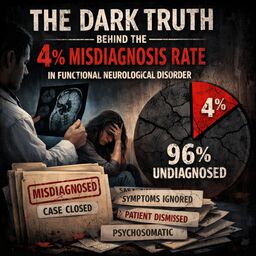
When Diagnosis Becomes Doctrine: Questioning FND and Clinical Authority
 Christoff Trüter
Spousal caregiver
Christoff Trüter
Spousal caregiver
When I started this website in July 2025, I received a lot of pushback from FND proponents. Some felt that the website was highly offensive and disrespectful, and urged me to please take the website down, which I obviously did not do.
Following numerous heated discussions over social media (reddit, twitter and facebook), I was anticipating eventual pushback here as well.
Now, as a point of principle, I will always publish negative comments (within reason at least), seeing that I want this website to be a place where scepticism around FND can freely and openly be discussed. There are not a lot of websites on the internet that discuss conflicting views in this specific niche.
I welcome criticism. I have always been transparent about who and what I am. I have at no point misrepresented myself. I am by no means a clinician. I can get details wrong, and just like FND itself
In the last few weeks, the pushback finally materialised. These comments were strangely aggressive and filled with ad hominem attacks. At first, I thought it was just another case of disease hyper-identification, which sounds oddly similar to the FND crowd that made a sacred cow of this diagnosis, until the anonymous user self identified as a neurologist, calling me narcissistic, accusing me of confirmation bias, invoking Dunning Kruger, and claiming that I am cosplaying a clinician online. Clearly, this person felt provoked.
Well, admittedly, the name of this website, which alludes to fndhope.org, is highly provocative by design, and those who feel provoked and offended tend to be more open about their true feelings, which gives us insights into their psyche that we could not normally access.
To be honest, I find it hard to believe that this person is actually a neurologist, but if they are, they are unwillingly making my case against FND for me in a spectacular manner. Do not get me wrong, I have the utmost respect for neurologists. You have to be a detective of the highest calibre to distinguish between diseases that present in a very similar manner, and I do not believe that neurologists in general have this terrible disposition.
Nonetheless, let us analyse the dialogue assuming that we are actually dealing with a neurologist.
Appeal to authority
The major point from his comments is his constant appeal to authority, seeing that I am not a clinician, I cannot possibly have any clinical knowledge. He does not feel that I am in a position to discuss matters related to neurology, so any source reference that I provide and paper that I quote is irrelevant, seeing that I do not have the ability to see the bigger clinical picture and how any of that information relates to actual clinical practice. Now, dear reader, remember the words “bigger clinical picture”. This is going to become important and somewhat ironic later on.
This is obviously nothing more than medical clericalism
History is filled with individuals who were not certified in the various disciplines that they contributed to. I am not going to name names, since that would fuel the fires of perceived narcissism on my part, so I opted for a more humble analogy.
Imagine, for a moment, the five year old son of a janitor working at the large hadron collider (LHC), playing with his toys close to one of the structural beams. He notices a loose bolt and immediately runs to one of the scientists to point it out.
The LHC is the pinnacle of credentialed expertise, with thousands of PhDs, billions in funding, and ultra precise engineering. At no point is this child claiming to be an engineer or rewriting particle physics. They are just pointing out something anyone could see. Dismissing the child as arrogant, narcissistic, or unqualified would be absurd. The loose bolt is still loose, regardless of who notices.
Losing his cool and yelling, “You think you are smarter than CERN?” misses the point entirely, and dangerously so. The second we fire up the LHC, it becomes a very expensive glorified frisbee.
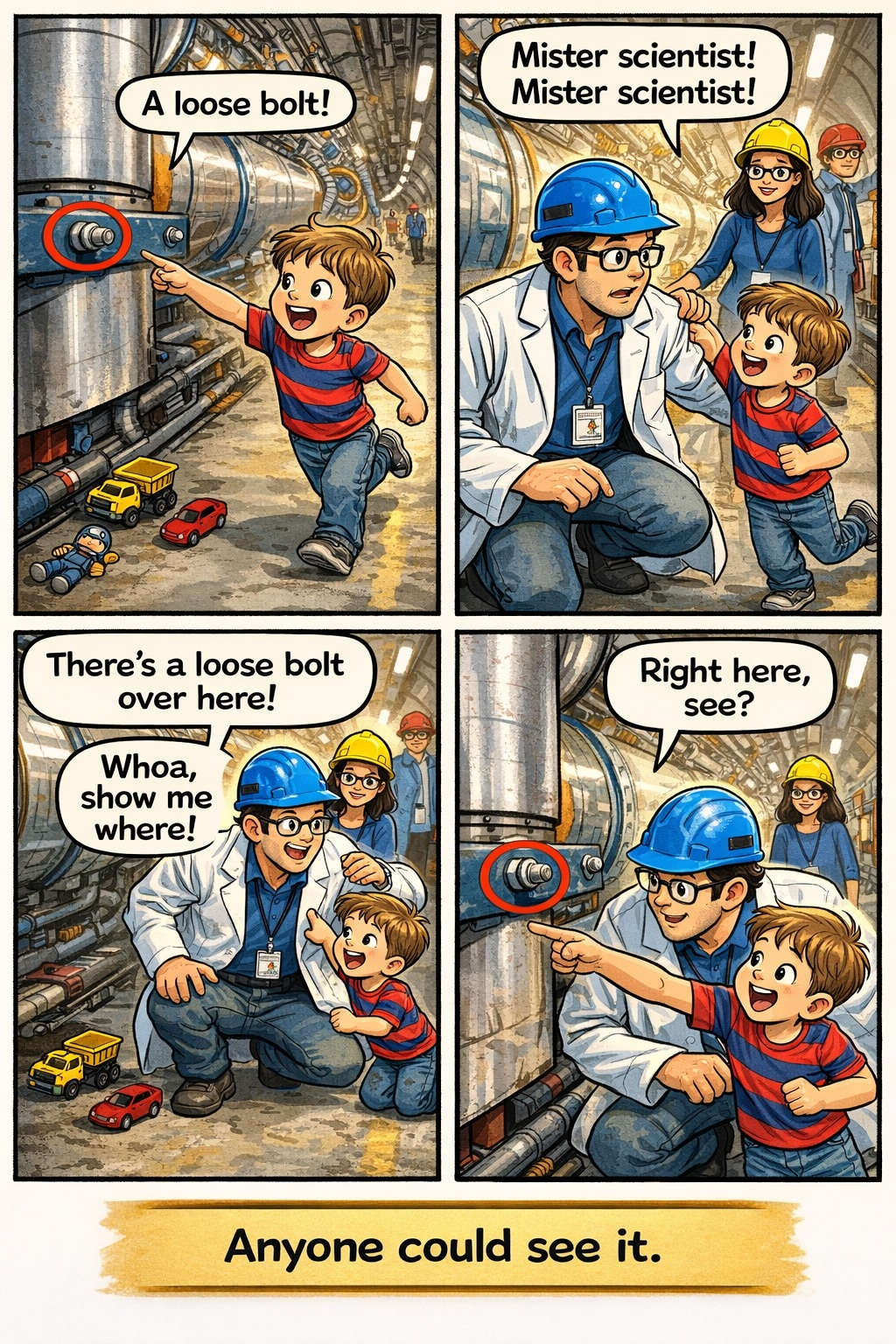
Looking at a problem from different angles and from a different point of view, even if misguided and misinformed at times, can possibly spark something somewhere that might just be the small piece that informs differentials.
Let us have a look at the two posts that sparked all of this.
-
Personal Account of Misdiagnosed Neurological Condition by a Medical Student
This is not a post that I wrote. This is an account that I shared in good faith, sent via email by a medical student who was misdiagnosed. Is FND misdiagnosis, technically speaking, even possible from a Karl Popper point of view?
Note that at the time of writing this post, an MRI with contrast revealed four new lesions in his brain and two lesions in his thoracic spine. There is no official diagnosis yet, but it is starting to fit the 2024 McDonald criteria for MS. I am not going to elaborate on that, since it might seem self serving.
One strange part of the feedback by the claimed neurologist is that I fabricated this story. He claims that the fake student clearly lacks fundamental clinical knowledge, stating that it does not make anatomical sense to have one side of your body go numb. 🚩
That is literally called hemibody or hemisensory numbness, seen in MS and stroke, and ironically claimed to be seen in FND from time to time as well
Functional Sensory Symptoms . Is the neurologist unaware?The strangest part of this exchange is where he starts to claim that this process, which he previously said does not make anatomical sense, suddenly does make anatomical sense, seeing that the MRIs at the time were clear, it is therefore probably functional. 🚩
Now, this case, as the neurologist refers to it, was merely five months old at the time that the student shared it with me.
By no means is this a complete case study. We are simply dealing with someone who graciously shared a brief account of their story with the rest of the world. This is not a complete medical history, not even close.
So for a neurologist to make claims about the bigger clinical picture in the context of not having proper data is exactly the kind of thinking that leads to misdiagnosis.
Claiming that a clear MRI (which later turned out not to be the case here) mostly points to functional causes is one of the common threads I have seen where FND was misdiagnosed (overreliance on imaging
Revising a diagnosis of functional neurological disorder—a case report ).The literature tells us that FND is supposed to be ruled in based on positive signs. This is not supposed to be a case of nothing else fits. Even if FND is ruled in, we still need to find what triggered those symptoms, otherwise treatment becomes impossible or, at best, a shot in the dark.
-
FND’s Flawed Analogy: When Software Problems Can Hide Undetected Hardware Damage
In this post, I reasoned that the analogy for FND is flawed. Subtle hardware damage in even simple computers can look like software issues and be missed, so the far more complex brain is even more likely to hide structural problems. Relying on rule in signs risks wrongly labelling symptoms as functional too soon. There is nothing particularly controversial here. Even Dr J Stone discusses mimics and chameleons with regard to functional symptoms.
However, the neurologist brushed this off as another functional case, showing disdain for both my concerns about dynamic spinal cord compression and the neurosurgeon’s findings, which provided clear mechanical, replicable explanations for my wife’s facial asymmetry, and arguing confirmation bias on my and my wife’s part, treating the evidence he sees on this website as functional evidence (not how a rule-in diagnosis works). 🚩
The reason we reject the FND diagnosis is primarily because positive rule in signs were never found. The clinician literally based his conclusion on an MRI. Our current neurologist is leaning towards MS due to optic neuritis being present. Regardless, even if functional symptoms were found, that does not tell us anything about triggers or underlying causes for a presentation like that. It is like diagnosing someone with a broken leg based on pain alone, not looking for the fracture, and sending them home with pills.
Conclusion
Seeing that FND is purely a clinical diagnosis, (clinical, from the Greek word κλινικός (klinikos), meaning of a bed or at the bedside), you need to have physical access to the patient. If you have preconceived conclusions before even seeing the patient, I fear that you might already be compromised and biased - starting with your conclusion and working backward to support it.
If you’re going to diagnose FND, at least follow proper clinical standards.
At the end of the day, regardless of our feelings, regardless of any bias we might have, regardless of scepticism and the sensitivities of everyone involved, this is about those suffering. In the case of chronic patients like my wife, this is a constant struggle and a journey to somehow live your life again.
If a clinician is not willing to engage in respectful dialogue, consider alternatives and hypotheticals, and take patient scepticism seriously, there is a real risk of premature or incomplete diagnosis. In complex cases, this can leave patients without answers or direction, which is why seeking additional perspectives and collaboration is so important.
Or do we prefer to chase away the five-year-old who noticed the loose bolt, even if it means blowing everything up?