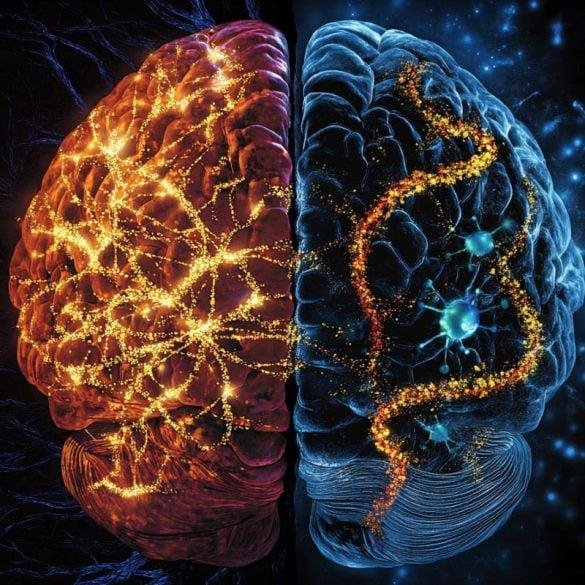
Different Causes, Same Symptoms: A New Theory of Functional Cognitive Disorder Raises Familiar Questions
 FND Nope
Moderator
A person suffers a concussion, develops persistent memory problems, and struggles with concentration, fatigue and everyday cognitive tasks. Another person reports remarkably similar difficulties without any documented head injury. Their symptoms overlap, their neuropsychological test results may look surprisingly similar, and both may eventually encounter the language of functional cognitive disorder. But does a similar clinical presentation mean the same underlying problem?
In September 2026, Mavroudis and colleagues published a theoretical review in Brain Sciences titled Functional Cognitive Disorder and Post-Concussion Memory Symptoms as Disorders of Distributed Memory Control: A Metacognitive–Systems Consolidation Framework. The authors propose that functional cognitive disorder (FCD) and persistent post-concussion symptoms (PPCS) may involve disturbances of the same distributed memory-control system, even when their proposed starting points are fundamentally different.
It is an ambitious explanation involving the hippocampus, prefrontal cortex, thalamus, sleep-dependent memory consolidation, predictive processing and neuroplasticity. It is also, as the authors repeatedly acknowledge, a hypothesis. No new patients were examined, no experimental data were generated, and the proposed unified mechanism has not been demonstrated. That distinction matters because the paper illustrates both the possibilities and the unresolved assumptions involved in explaining overlapping neurological symptoms.
Two Routes to Similar Cognitive Symptoms
The authors distinguish between two proposed pathways. In FCD, they suggest that the disturbance begins primarily through altered metacognitive processes: how individuals evaluate their own memory performance, interpret cognitive mistakes and form expectations about future performance. In PPCS, the proposed starting point is an actual neurological injury that disrupts metabolic activity, attention, sleep and communication between brain networks. Both pathways are then hypothesised to converge on difficulties regulating memory retrieval and evaluating cognitive performance.
The distinction is important because the authors do not dispute that concussion causes genuine biological injury. They describe the neurometabolic cascade following mild traumatic brain injury, including changes in neuronal signalling, energy demand and network connectivity. They also acknowledge that conventional structural imaging can appear normal despite measurable neurological disturbances. Their argument is that, in some patients, the persistence of symptoms may involve additional processes beyond the initial injury.
For FCD, the proposed explanation centres on an internal model of cognitive failure becoming excessively resistant to correction. A person may perform adequately on a memory task yet remain convinced that their memory is severely impaired. The authors interpret this discrepancy through predictive processing, excessive self-monitoring and an idea borrowed from machine learning known as overfitting. In simplified terms, they propose that the brain becomes too strongly calibrated toward an expectation of failure and struggles to incorporate contradictory experiences.
For PPCS, the theory begins with physical injury but suggests that disturbed sleep, fatigue, attentional demands and other factors may contribute to persistent difficulties. The authors further propose that concussion could act as a gateway to FCD in susceptible individuals, creating a continuum between predominantly injury-related symptoms, mixed presentations and predominantly functional cognitive symptoms.
There is an obvious complication. The proposed continuum depends on distinguishing how much of an individual's presentation arises from continuing biological consequences of injury and how much arises from the proposed metacognitive disturbance. Yet the paper does not establish a validated method for making that distinction in an individual patient. The authors explicitly describe their suggested classification criteria as provisional heuristics with unknown sensitivity and specificity.
The Neuroplasticity Explanation
A central component of the paper is maladaptive neuroplasticity. Neuroplasticity describes the nervous system's capacity to change through experience, learning and injury. The authors propose that the same biological processes that ordinarily support memory formation and neurological recovery may also reinforce unhelpful patterns of activity. They suggest that repeated attention to cognitive failures, disrupted sleep and persistent expectations could strengthen patterns that contribute to ongoing symptoms.
The problem is not that neuroplasticity is imaginary. It is a well-established biological phenomenon. The problem is moving from that general fact to a specific explanation of FCD without demonstrating the proposed causal pathway. Evidence that synaptic plasticity exists, or that brain connectivity differs between certain clinical groups, does not independently establish that an individual's memory complaints are caused by an overfitted internal model.
The authors recognise some of these evidential gaps. They acknowledge that the proposed involvement of anteromedial thalamic gating during memory retrieval has not been demonstrated in humans, that its miscalibration in FCD has not been observed, and that the suggested role of dream-mediated regularisation remains untested. Findings from animal experiments and other neurological conditions provide theoretical support, but they cannot automatically be treated as direct confirmation of the proposed mechanism in FCD.
This is particularly relevant when mechanistic theories are translated into clinical explanations. A plausible account of how symptoms might arise is not equivalent to evidence that those symptoms arose through that mechanism in a particular patient.
Different Causes, Similar Phenotypes
Perhaps the most interesting aspect of the paper is its recognition that similar cognitive presentations may emerge from different starting points. The authors propose a predominantly top-down pathway for FCD and a predominantly bottom-up pathway for PPCS, while acknowledging that both may produce overlapping clinical features. Their model therefore treats the similarity of symptoms as something requiring an explanation, rather than assuming that identical symptoms necessarily imply identical origins.
This has a clear conceptual connection to the Common Phenotypes Hypothesis discussed on this website. That hypothesis questions whether clinical patterns currently grouped under functional neurological diagnoses may sometimes represent shared phenotypes arising from different underlying biological processes. It asks whether the recognisable presentation is being mistaken for a sufficiently established explanation of its cause.
There is, however, an important difference between the two proposals. Mavroudis and colleagues interpret the convergence as support for a unified disturbance of distributed memory control, with maladaptive plasticity acting as a common maintaining mechanism. The Common Phenotypes Hypothesis raises a more fundamental question: whether convergence at the level of symptoms or clinical signs necessarily establishes a distinct functional disorder, rather than a pattern that may arise through multiple mechanisms.
The paper does not prove the Common Phenotypes Hypothesis, nor does it independently validate its broader implications for functional neurological disorder. What it demonstrates is that researchers working within the functional-disorder literature are themselves proposing models in which different initiating processes produce overlapping clinical presentations. That is a useful point of comparison, even where the proposed explanations diverge.
Where the Evidence Stops
The paper deserves credit for distinguishing established observations from animal-derived findings and new hypotheses. It also sets out eight testable predictions, including proposed differences in memory recognition and recall, metacognitive accuracy, sleep-related variability, brain connectivity and responses to different interventions. These predictions provide opportunities to challenge the model experimentally rather than accepting it simply because it sounds neurologically sophisticated.
Nevertheless, several diagnostic questions remain unresolved. Neuropsychological testing samples particular cognitive abilities under particular conditions. Relatively preserved performance does not establish that every aspect of cognition is functioning normally, nor does it identify the cause of symptoms experienced outside the testing environment. Similarly, inconsistency between reported difficulties and observed performance may be clinically informative, but it does not independently demonstrate that excessive self-monitoring or maladaptive expectations caused that inconsistency.
The authors themselves identify alternative explanations and important differential diagnoses, including early neurodegeneration, depression, anxiety, sleep disorders, thyroid dysfunction, medication effects and attention-deficit/hyperactivity disorder. These possibilities matter because a proposed functional mechanism should not become a substitute for investigating conditions capable of producing similar complaints.
There is also a risk of circular reasoning if the model is applied without independent verification. A discrepancy between symptoms and test performance is interpreted as evidence of metacognitive miscalibration, while metacognitive miscalibration is then invoked to explain the discrepancy. The proposed framework becomes scientifically stronger only when its mechanisms can be measured independently and shown to distinguish affected patients from appropriate comparison groups.
To their credit, the authors do not claim that these questions have already been resolved. Their conclusion explicitly presents the framework as a hypothesis awaiting testing. The concern arises when a theoretical explanation is treated in clinical practice as though its proposed mechanisms were already established facts.
What This Paper Actually Contributes
This review offers a detailed attempt to explain why patients with different clinical histories may experience similar cognitive symptoms. It integrates established memory neuroscience with proposed metacognitive mechanisms, recognises the biological reality of concussion, and identifies experimental predictions that could support or undermine its account. Those are meaningful contributions to a field where the relationship between symptoms, clinical signs and underlying mechanisms remains contested.
But it does not demonstrate that persistent post-concussion symptoms become functional through maladaptive learning, that an overfitted self-model causes FCD, or that the proposed continuum can reliably distinguish functional from continuing injury-related cognitive impairment. These remain questions for future research.
Similar symptoms may reflect disturbances in overlapping neurological systems. What remains to be established is whether those similarities identify a common causal mechanism, different mechanisms producing a shared phenotype, or some combination of both.
For the Common Phenotypes Hypothesis, the relevance is not that this paper confirms our interpretation. It is that the authors recognise a problem central to that interpretation: clinical similarity does not automatically settle the question of causation. Their proposed solution is a unified functional memory-control framework. Ours asks whether the shared presentation itself may be receiving more diagnostic certainty than the available mechanistic evidence warrants.
Both proposals ultimately need to withstand empirical testing. Until then, the distinction between an observed clinical phenotype and a demonstrated explanation for that phenotype should remain firmly in view.
References
- Mavroudis, I., Das, O., Petridis, F., & Kazis, D. (2026). Functional Cognitive Disorder and Post-Concussion Memory Symptoms as Disorders of Distributed Memory Control: A Metacognitive–Systems Consolidation Framework. Brain Sciences, 16(10), 1026.
- Bhome, R., et al. (2022). Metacognition in functional cognitive disorder. Brain Communications, 4, fcac041.
- McWhirter, L., Ritchie, C., Stone, J., & Carson, A. (2020). Functional cognitive disorders: A systematic review. The Lancet Psychiatry, 7, 191–207.
This post explores a hypothesis. It should not be read as an established fact or settled scientific conclusion.