When Conversion Disorder Was Actually a Rare Prion Disease
 FND Nope
Moderator
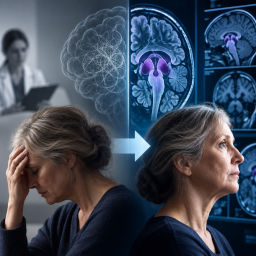
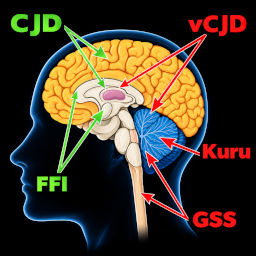
A 2025 case report published in the Journal of Medical Case Reports describes a woman whose early neurological symptoms were diagnosed as conversion disorder before progressive deterioration and genetic testing eventually established Gerstmann–Sträussler–Scheinker syndrome (GSS), a rare inherited prion disease. The authors themselves describe the earlier conversion disorder diagnosis as a misdiagnosis.
The case is particularly relevant because the initial functional diagnosis followed investigations that were reported as unremarkable. The report does not describe positive functional signs such as entrainment, distractibility, inconsistency or another examination finding as the basis for the conversion disorder diagnosis. What it does document is an early neurological presentation, normal investigations, a conversion disorder diagnosis, subsequent progression, and finally a specific genetic finding that established the underlying disease.
Initial presentation and conversion disorder diagnosis
The patient first presented to the Department of Neurology at University Hospital Münster in January 2019 with intermittent tremor, dysarthria and psychomotor slowing. MRI, EEG and lumbar puncture were performed and were reported as unremarkable. According to the authors, a diagnosis of conversion disorder was then made.
“According to medical records, the patient first presented to the Department of Neurology at the University Hospital Münster in January 2019 with intermittent tremor, dysarthria, and psychomotor slowing.”
The paper provides little further information about how the conversion disorder diagnosis was established. It does not report documented positive functional neurological signs or explain how the intermittent tremor, speech disturbance and psychomotor slowing were demonstrated to be functional. The sequence presented in the medical history is straightforward: neurological symptoms were investigated, MRI, EEG and lumbar puncture were unrevealing, and conversion disorder was diagnosed.
The illness continued to progress
The patient's condition did not remain static. By March 2022 she had developed progressive deterioration in her speech, including difficulty finding words and constructing sentences. She was also experiencing gait disturbance and recurrent falls. Investigations over this period increasingly began to show abnormalities, including cerebral atrophy on imaging, significant impairment on neuropsychological testing and later EEG evidence consistent with encephalopathy.
The progression matters because the early normal investigations had not established the absence of neurological disease. They had established only that those particular investigations had not identified its cause at that stage. As the disease progressed, abnormalities became increasingly apparent.
A significant family history
There was also an important clue in the patient's family history. Her father and paternal grandmother had developed a similar pattern of neurological illness and died prematurely. GSS is an autosomal-dominant inherited prion disease, making that history particularly relevant once an inherited neurodegenerative disorder was considered.
Genetic investigation eventually provided the answer. In January 2023, molecular genetic testing at University Hospital Münster confirmed GSS. Long-read sequencing showed that both the patient and her father carried an insertion of nine additional octapeptide repeat units in the PRNP gene, known as a 9-OPRI mutation. The authors note that this particular mutation is exceptionally rare, with only a handful of cases previously reported in the medical literature.
From intermittent symptoms to severe neurological disease
By August 2023 the patient was admitted to psychiatry with severe confusion and agitation after a neurological admission. She experienced marked restlessness, profound sleep disturbance, recurrent falls, mood changes, stereotyped behaviour and severe disorientation. At times she failed to recognise her husband and child. Her condition continued to progress, with severe gait instability, imbalance, dysarthria and increasing dependence on others for care.
Three months after an initial psychiatric admission she was readmitted with further progression. She eventually became unable to walk without assistance because of severe imbalance and impaired gait, while dysarthria substantially restricted verbal communication. The progressive neurodegenerative illness ultimately required extensive family support and involvement from neuropalliative care.
The authors call the original diagnosis a misdiagnosis
There is little ambiguity in how the authors interpret the earlier conversion disorder diagnosis. In their discussion they state that the diagnosis of GSS was confirmed only after years of symptoms and specifically describe the conversion disorder diagnosis as a misdiagnosis. Their conclusion makes the same point.
“The patient initially presented with an atypical and intermittent speech disorder, tremors, and slowed movements, which led to a misdiagnosis of conversion disorder.”
The authors identify the positive family history as the reason for pursuing PRNP genetic analysis, which ultimately established the diagnosis. They also discuss the difficulty of diagnosing prion diseases and suggest that advances in genetic testing may allow earlier and more accurate investigation of similar cases.
What this case demonstrates
This case is not simply an example of one rare disease being difficult to diagnose. It also illustrates the problem with treating unrevealing investigations as evidence for a functional explanation. MRI, EEG and lumbar puncture were initially normal, but the patient nevertheless had a progressive inherited neurodegenerative disease. The biological process had not been excluded; it had simply not yet been identified.
There is also an important limitation in the published account. We cannot reconstruct the entire 2019 neurological examination from this case report, so it would be unreasonable to claim that no functional signs were observed. What can be said is that the authors do not document them when describing why conversion disorder was diagnosed. The evidence they explicitly report from that period consists of intermittent neurological symptoms and unremarkable MRI, EEG and lumbar puncture.
The distinction is important. A normal test result is evidence about what that particular test detected at that particular point in time. It is not, by itself, evidence that unexplained neurological symptoms are functional. In this patient, the subsequent course eventually made that distinction unmistakable.
Six years to a diagnosis
The authors report that the final diagnosis was confirmed six years after symptom onset and following the conversion disorder misdiagnosis. Genetic testing ultimately supplied something the earlier diagnosis had not: a specific biological finding capable of explaining the progressive neurological disease, supported by the presence of the same mutation in her affected father.
This is also not the only published case of GSS initially being interpreted as a functional or conversion disorder. Another published case, Gerstmann–Sträussler–Scheinker syndrome misdiagnosed as conversion disorder, described a different patient whose illness was initially given the same type of diagnosis. The present case therefore adds another independently published example involving a genetically established prion disease.
Source
Atil ES, Lenz P, Baune BT, Sarkheil P. Psychiatric presentation of Gerstmann–Sträussler–Scheinker disease with 9-OPRI mutation in PRNP gene: a case report. Journal of Medical Case Reports. 2025;19:628. DOI: 10.1186/s13256-025-05700-6.