Why Calling It FND Can Be Misleading and Potentially Dangerous
 Christoff Trüter
Spousal caregiver
Christoff Trüter
Spousal caregiver
As you might have noticed by now, I am not particularly convinced of the legitimacy of FND as a standalone diagnosis. I believe it is more likely a CNS knee-jerk reaction or referral to underlying causes, rather than a primary cause in itself. In other words, it may be something commonly observed as a consequence of an underlying illness (as pain is to fractures), not something that should automatically be treated or diagnosed as the illness itself, as is increasingly common practice these days.
This is not a case of dismissing the lived experience of those suffering from this condition, and let us not get distracted or manipulated by those experiences, which are often used by proponents of this disorder to prematurely end discussion. Rather, let us keep dialogue open.
The biggest red flag, in my view, is the issue of falsifiability, meaning the ability to prove a misdiagnosis. As previously discussed on this website, I believe the comorbidity claim that FND can be diagnosed alongside other diseases functions as a form of diagnostic shielding, effectively protecting the diagnosis from challenge by confusing presentation with cause.
In recent years, the following have commonly been "misdiagnosed" as FND.
- Psychopharmacological withdrawal (especially antidepressants, benzodiazepines, and other CNS-active drugs)
- ME/CFS or Long Covid
- Vitamin B12 deficiency (and other nutritional deficiencies such as B1, B6, D, magnesium, etc.)
- Small Fiber Neuropathy
- Mast Cell Activation Syndrome (MCAS) / Histamine Intolerance
- Autoimmune / Auto-inflammatory conditions (e.g., POTS, autoimmune encephalitis, Sjögren’s, lupus)
- Toxin exposures / Mold illness / Chronic infections (Lyme and co-infections, EBV reactivation, etc.)
- Genetic / Channelopathies (e.g., SCN9A as in Maddie Aumann’s case (mentioned at the bottom of the post), other ion channel disorders)
- Endocrine disorders (thyroid dysfunction, adrenal insufficiency, sex hormone imbalances)
- Craniocervical Instability (CCI) / Tethered Cord / Spinal issues
I am, of course, using the term “misdiagnosed” loosely here, since I do not believe it is possible to misdiagnose FND, instead, such cases are typically described as comorbid with FND, rather than being recognised as a CNS reflex reaction. This framing shifts FND away from a reflex-based interpretation and instead positions it as an action disorder.
For the sake of this post, let us ignore the fact that doctors are human and can certainly misconstrue a symptom as being functional, whether due to lack of experience or, bluntly put, a moment of incompetence. It is always important to understand why a clinician reached a particular conclusion. It cannot simply be a case of nothing else fits, we need positive signs.
It is very difficult to get into the minds of clinicians. I did, however, recently review some feedback, courtesy of the @recover2renew X account.
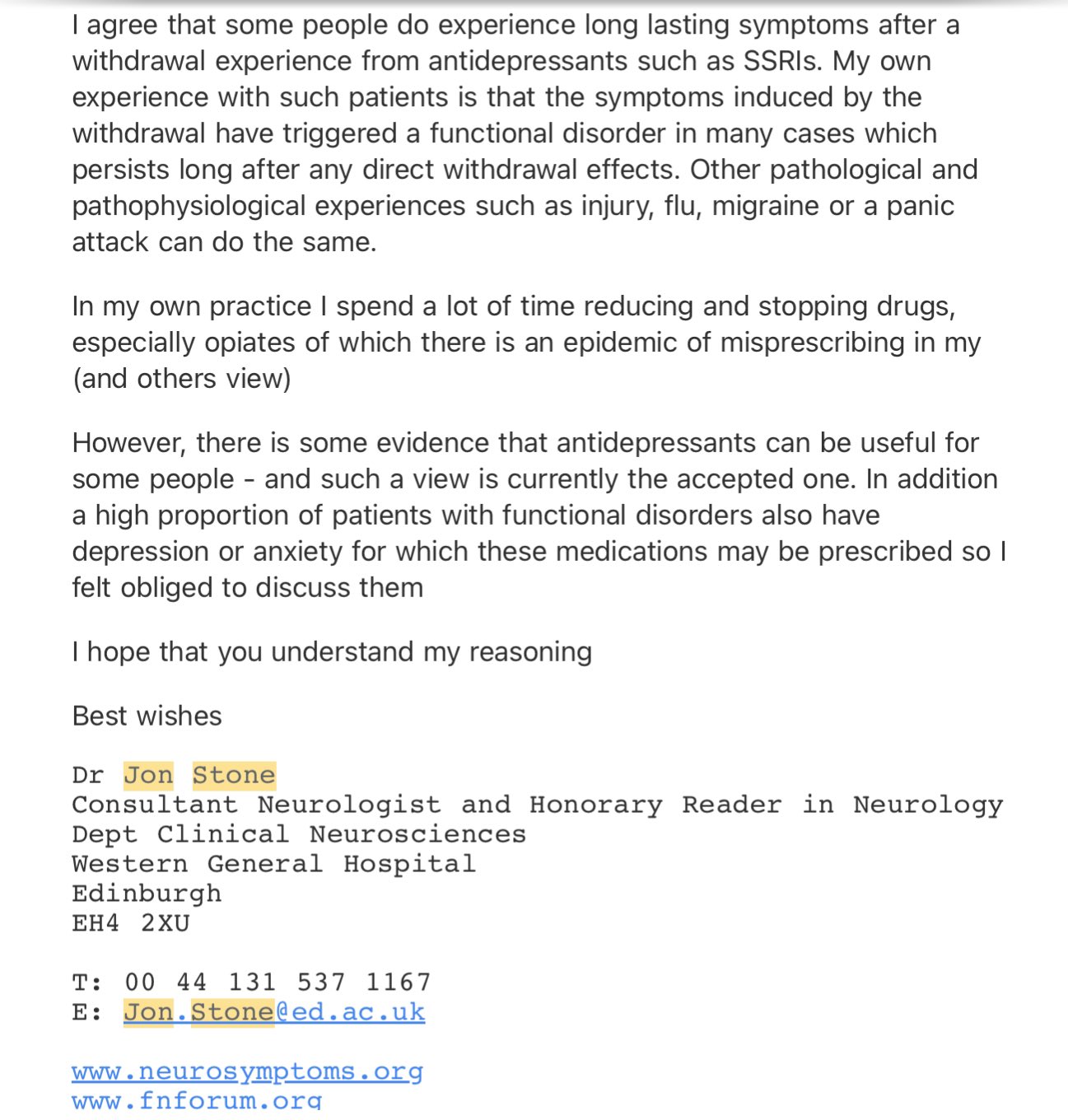
In the first email, Prof J Stone notes the possibility and evidence of antidepressant withdrawal being the triggering event for FND in certain cases.
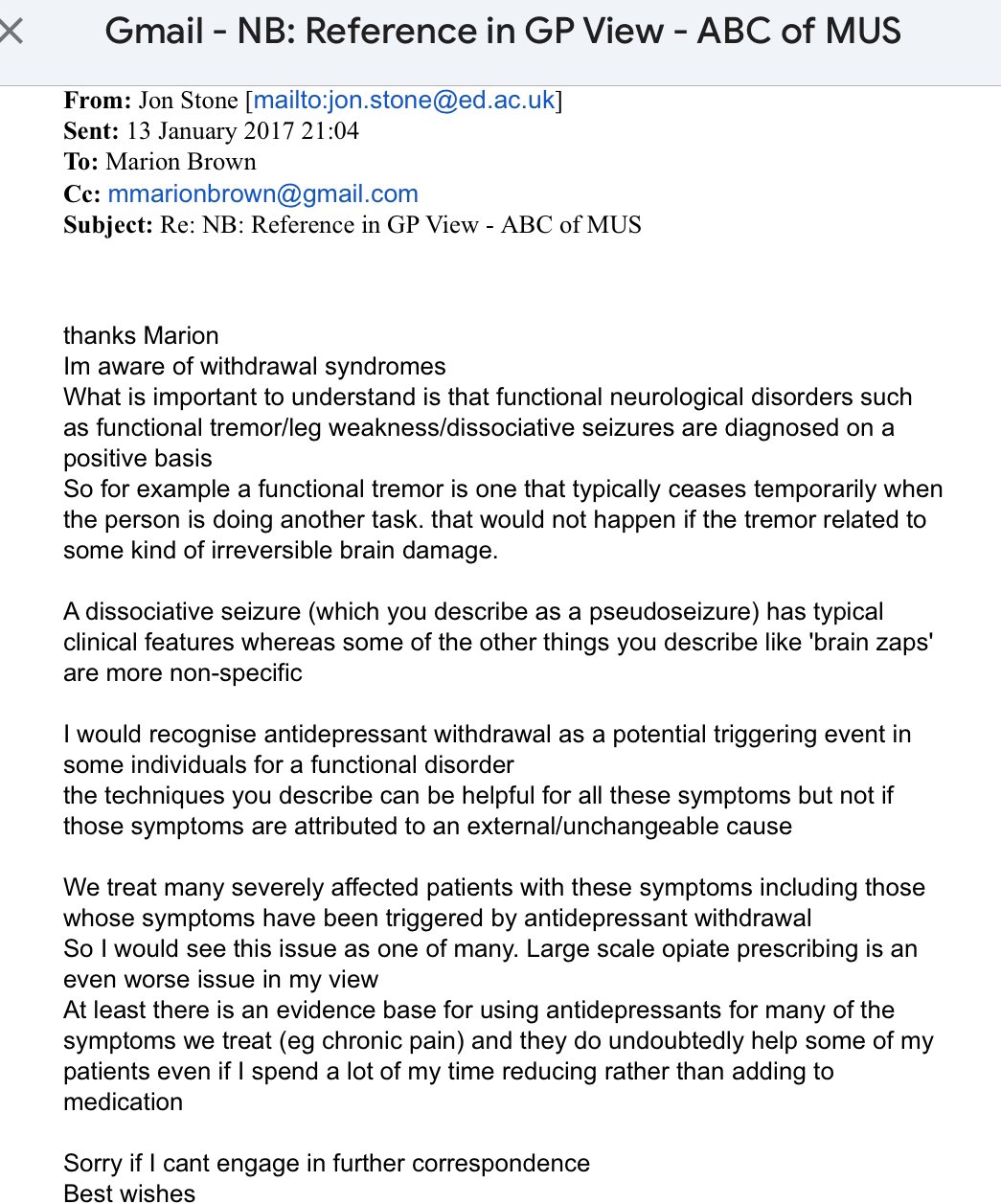
The second email is a bit of a if my neck hurts do not turn it moment, in which Prof J Stone advises simply restarting antidepressant use, even mentioning that it can be useful for some FND patients regardless. The trigger, he suggests, is probably serotonin dysfunction in certain cases.
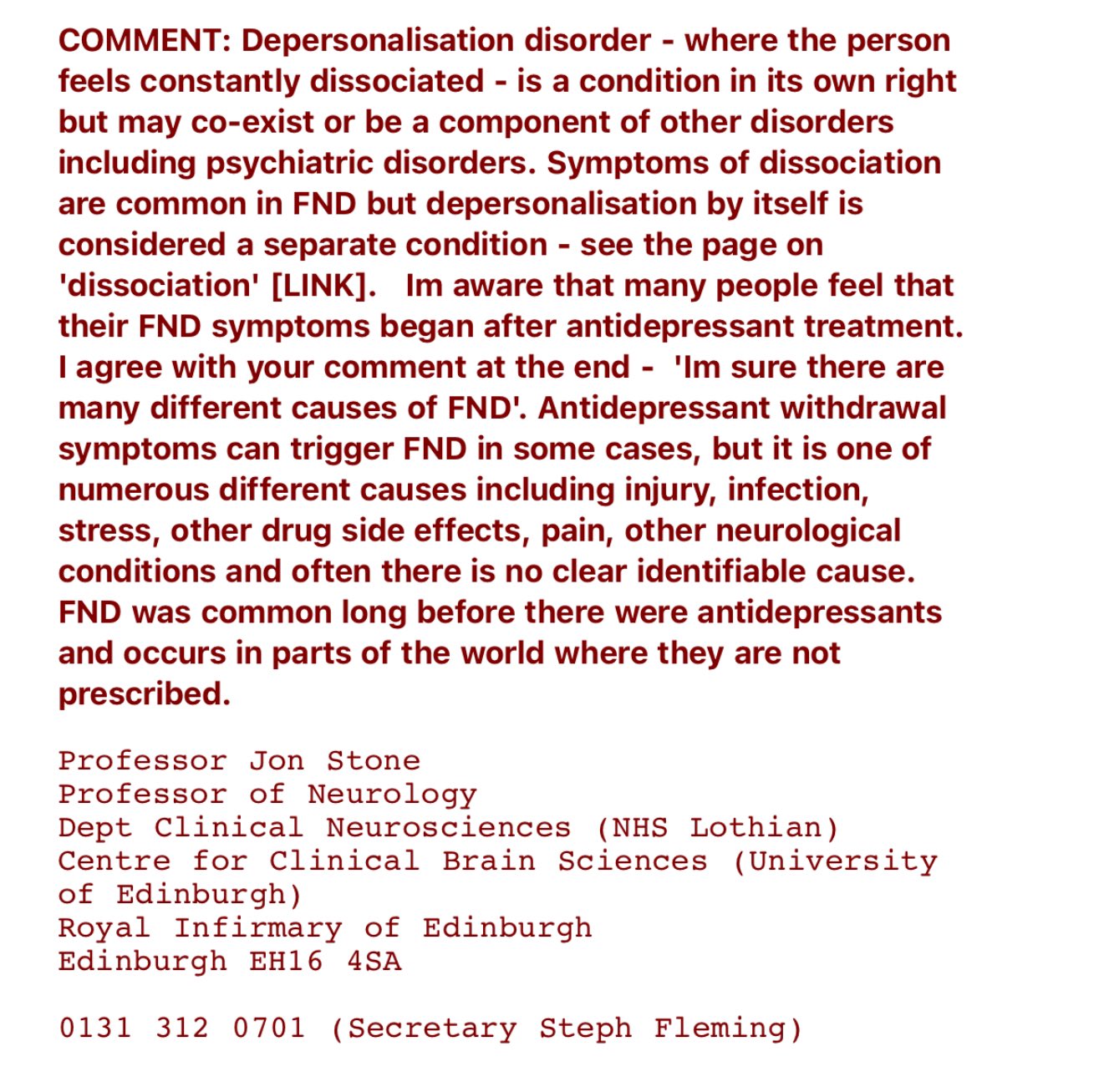
The last email is also quite interesting, where Prof J Stone suggests that injury, infection, stress, other drugs, pain, and even other neurological conditions might trigger FND.
Which brings me back to my original point. If even Dr J Stone, often regarded as a leading figure in FND research, refers to factors that can trigger functional symptoms, why are we even calling this FND at all? Why not simply describe it for what it appears to be, a CNS reflex reaction, and by naming presentations as primary disorders, we may be confusing presentation with cause?
Why do I even care about calling it a CNS reflex?
The answer is simple. When FND is used as a primary diagnosis, we run the risk of prematurely closing diagnostic doors. This commonly happens with FND and is reflected in the often cited statistic that around 80 to 85 percent of patients feel they are not being heard.
Bluntly put, when functional symptoms like these are observed, in my humble opinion, wouldn’t it be safer to say: "This looks like a CNS reflex. My work here is not done. I still need to identify the triggers and the underlying cause of these symptoms, whether they are an echo of a past illness or a vibration of a current one."
Failing to do this is comparable to a cardiologist recognising referred pain, ruling the referred pain presentation as a disorder in itself, and then ignoring the underlying cardiac distress because it is not clearly traceable.
Ultimately, this can be dangerous and potentially fatal in the worst case scenario. I would therefore urge clinicians to properly monitor their patients.
In October 2024, Maddie Aumann died at the age of 17 after spending her life battling a rare genetic disorder that was initially diagnosed as FND.
Working together, Missouri State Rep Tricia Byrnes and Maddie helped craft proposed legislation now known as Maddies Law, House Bill 2513, aimed at improving diagnostic accuracy and strengthening protections for children with medically complex conditions. I am watching this bill closely and hope it will be extended beyond children as well.
@fox2now Two bills will be debated in Jefferson City to improve care for children with complex medical conditions, inspired by the death of 17-year-old Maddie Aumann. The proposed “Maddie’s Law” seeks to ensure accurate diagnoses and require clear treatment plans for such cases.
♬ original sound - FOX 2 - St. Louis
In cases like this, FND proved to be a diagnostic bias that hindered further investigation, or as Prof J Stone might put it, the genetic disorder triggered FND, which is ultimately a useless framing.
Please keep diagnostic doors open.
References
- National Mental Health Commission (Australia, 2019): 80% of survey respondents reported distressing experiences in health services, including symptoms being dismissed or patients being accused of faking
- FND Hope International Stigma Survey (~500 participants): 85% of patients felt dismissed, disrespected, or not believed by medical professionals