Is FND a diagnosis of exclusion? A Monte Carlo simulation
 FND Nope
Moderator
FND Nope
Moderator
Officially, FND is not a diagnosis of exclusion, it is described as a disorder with positive rule-in signs, signs that can appear regardless of other neurological diseases and sometimes even improve when those comorbid disorders are treated.
In reality, however, the picture is less clear. The literature presents extremes, some clinicians still consider FND a diagnosis of exclusion, while others view positive rule-in signs as helpful but not essential, believing that functional disorders can be reliably diagnosed using esoteric knowledge applied to the overall clinical picture.
This open-endedness is a bit too broad for my liking, but exploring that scepticism is beyond the scope of this post.
Instead, I will focus on the official criteria as outlined in the DSM-5.
| Criteria | Description |
|---|---|
| A | One or more symptoms of altered voluntary motor or sensory function. |
| B | Clinical findings provide evidence of incompatibility between the symptom and recognized neurological or medical conditions. |
| C | The symptom or deficit is not better explained by another medical or mental disorder. |
| D | The symptom or deficit causes clinically significant distress or impairment in social, occupational, or other important areas of functioning or warrants medical evaluation. |
However, further down in the FND section:
The diagnosis is not one of exclusion and can be made in individuals
who also have neurological diseases like epilepsy or multiple sclerosis.
English is my second language (I am by no means an English scholar), and when I first obtained a copy of the DSM-5, I was struck by how imprecise and awkward parts of the writing seemed. I later realised this was not just my impression, as even Dr Allen Frances (Chair of the DSM-4) raised similar concerns.
Systematic cover-to-cover reading of any DSM-5 to identify all its technical errors would be either cruel punishment or a sure cure for insomnia, or both. I must admit I didn’t have the heart or fortitude or time to do the entire marathon. But even my casual and selective reading of DSM-5 picked up egregious mistakes on almost every page I read—including some that will undoubtedly cause great confusion.
The DSM-5 writing is remarkably amateurish—even more imprecise than I expected and my predictions for it were pessimistic.
DSM-5 Badly Flunks the Writing TestAllen Frances, MD
The DSM-5’s FND definition reads like a text requiring harmonisation, similar to biblical hermeneutics and exegesis, often defended by its own apologists. Even though the DSM-5 states that FND is not a diagnosis of exclusion, it includes exclusionary criteria, criteria that apologists argue are common medical practice and appear throughout other DSM-5 diagnoses. Why that contradiction should make FND non-exclusionary is unclear, but we can run with it for now.
My main interest here is illustrating Dr Allen Frances’ point about diagnostic inflation, by showing how small changes in criteria wording can dramatically expand the number of people who qualify for a diagnosis.
Since I lack actual FND case data, I created a Monte Carlo simulation, based on UK neurology clinic statistics and published prevalence figures.
I then applied three sets of criteria to the simulated population, the DSM-4 criteria for Conversion Disorder, the DSM-5 criteria for FND, and a third set using only the positive rule-in criteria, which is technically sufficient. I could not apply a fourth unspecified criterion, as it cannot be coded.
From a simulated population of 68 million:
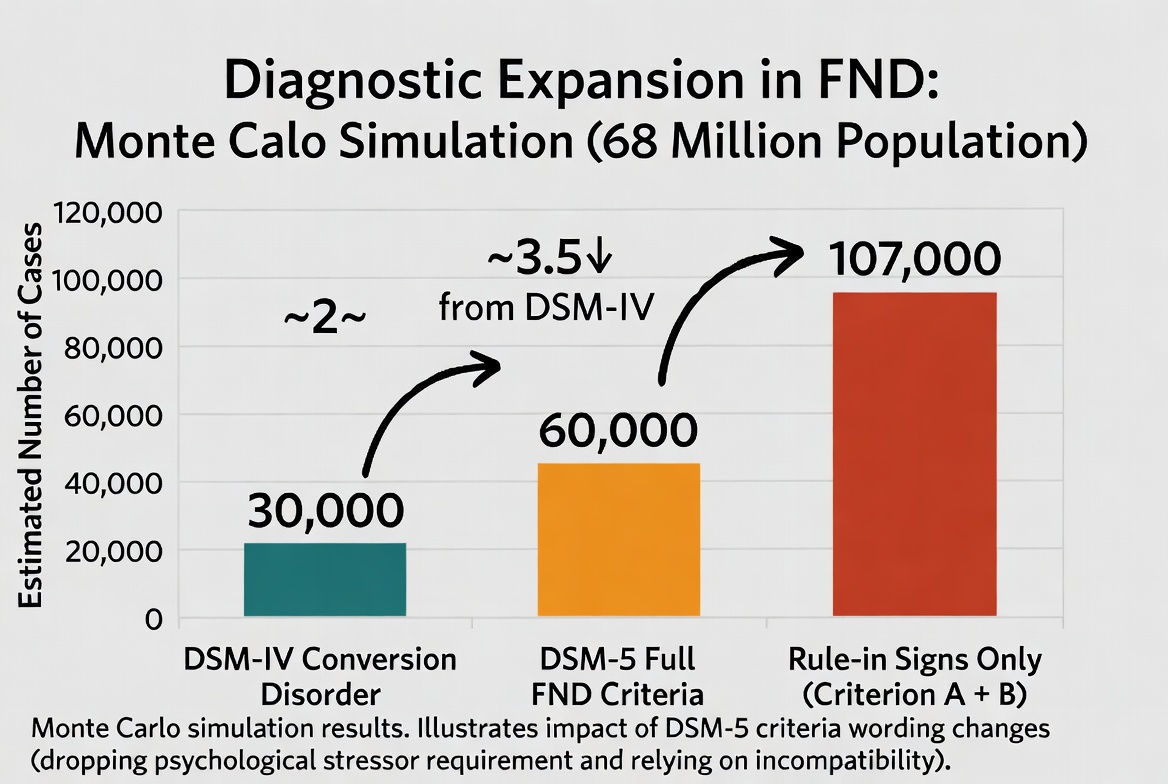
The DSM-4 criteria identified roughly 30,000 patients with Conversion Disorder (the older criteria Dr J Stone's 4% misdiagnosis rate for FND is based on).
public bool MeetsCriteria(PatientPresentation p)
    =>  p.HasNeurologicalPresentation &&          // Criterion A – symptom affecting voluntary motor or sensory function
        p.StressorLinkedToSymptom &&              // Criterion B – psychological factors associated with symptom onset/exacerbation
        p.HasNoBetterExplanation &&               // Criterion C – symptom not fully explained by a medical condition
        !p.IsIntentionallyProduced &&             // Criterion D – symptom not intentionally produced (excludes factitious disorder/malingering)
        p.CausesSignificantDistressOrImpairment;  // Criterion E – symptom causes clinically significant distress or impairment
Full DSM-5 FND criteria identified almost double that — around 60,000 cases.
public bool MeetsCriteria(PatientPresentation p)
    => p.HasNeurologicalPresentation &&          // Criterion A: One or more symptoms of altered voluntary motor or sensory function
        p.IsIncompatibleWithKnownNeurology &&    // Criterion B: Rule-in Clinical findings provide evidence of incompatibility with recognized neurological/medical conditions
        p.HasNoBetterExplanation &&              // Criterion C: Not better explained by another medical or mental disorder
        p.CausesSignificantDistressOrImpairment; // Criterion D: Causes clinically significant distress or impairment (or warrants medical evaluation)
Using only the positive rule-in signs (Criterion A + B) identified about 107,000 cases — over 3.5 times more than the old criteria.
public bool MeetsCriteria(PatientPresentation p)
    => p.HasNeurologicalPresentation &&     // Criterion A: One or more symptoms of altered voluntary motor or sensory function
        p.IsIncompatibleWithKnownNeurology; // Criterion B: Rule-in Clinical findings provide evidence of incompatibility with recognized neurological/medical conditions
The simulation demonstrates that the DSM-5 criteria for FND substantially broaden the diagnosis compared with DSM-4 Conversion Disorder, creating several implications:
- Diagnostic expansion: DSM-5 identifies roughly twice as many cases as DSM-4 under full criteria, and over three times as many when only rule-in criteria are used.
- Reclassification rather than replacement: A substantial proportion of DSM-4 cases are retained within DSM-5, indicating continuity alongside expansion.
- Sensitivity to criteria selection: Removing exclusionary and impairment requirements significantly increases case numbers, suggesting that small changes in application can materially affect prevalence.
- Co-occurrence with neurological conditions: A notable proportion of simulated cases meet criteria despite having other neurological disorders, reinforcing that FND is not strictly exclusionary in practice.
- Interpretation variability: Broader and less tightly constrained criteria increase the likelihood of variation between clinicians.
The simulation shows DSM-5 roughly doubles to triples FND cases versus DSM-4. The biggest risk is diagnostic overshadowing: genuine organic conditions risk being prematurely labelled functional, delaying investigation and treatment.
Tighter criteria and greater caution are needed.