Fatigable Weakness vs Functional Weakness: Why Hoover’s Sign Can Mislead When Isokinetic Testing Shows Otherwise
 Christoff Trüter
Spousal caregiver
Christoff Trüter
Spousal caregiver
I will not go into the detailed mechanics of Hoover's sign; you can read more about it here.
I am, however, more interested in understanding how clinicians determine whether this sign is appropriate in various clinical practices (the right tool for the job). In this post, we will also discuss how isokinetic testing can provide objective insights when evaluating limb weakness.
Case Context
Patient X (a 100m sprinter) initially reported decreased muscle strength. As a result, they enrolled at a high-performance centre (HPC), undergoing frequent isokinetic testing that measured various performance metrics regularly.
A few months later, the patient began struggling to close their eyes at night. Forcibly closing them caused dizziness and vertigo. One morning, the patient woke up completely off balance, resembling a middle ear infection. A GP evaluated the patient, concluded it was not a middle ear infection (despite red eardrums), and referred them to a neurologist.
Due to limited availability of appointments, exacerbated by the early COVID-19 pandemic, the next consultation was several months away. In the meantime, the patient’s balance worsened, prompting them to use a wheelchair and a cane for mobility.
As preparation, previously recorded isokinetic data from the HPC was exported for the neurologist. The data revealed that, despite rehabilitation efforts, the patient exhibited a consistent 20 to 40 percent strength deficit between the left and right sides, with the dominant right side being weaker.
Clinical Considerations
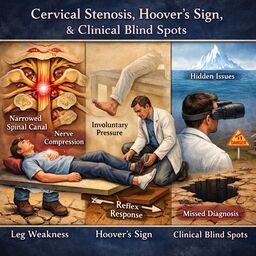
Hoover's sign is typically used when a patient presents with weakness or paralysis in one or more limbs, but involuntary activation demonstrates normal strength. A positive Hoover's sign is often interpreted as functional limb weakness.
In this case, its appropriateness is questionable, a misinterpretation of the patient’s reported symptoms (e.g. fatigability vs primary weakness) could lead to incorrect assumptions about the nature of the deficit and the choice of clinical tests:
- The patient arrives in a wheelchair but is able to walk. The wheelchair is used due to balance issues, not weakness.
- The patient reports fatigable weakness in the right side and provides objective isokinetic data confirming this claim.
The initial output of both legs looks normal, especially at the slower speed where force production is highest. There’s no obvious failure to generate force at the start (the actual domain where Hoover’s sign operates).
The deficit only becomes apparent once demand increases (higher speeds or repeated repetitions), where the right side drops off faster.
Overall, both legs can generate force, but the right one cannot maintain it under stress.
Actual Clinical Setting
- The clinician claimed ninety-nine percent certainty of functional diagnosis before even seeing the patient.
- Objective isokinetic data was dismissed as “too technical” and excluded from the assessment.
- Hoover's sign was applied regardless.
Analysis
While Hoover’s sign is a commonly used bedside tool to identify functional limb weakness, its application in cases of fatigable weakness appears inappropriate.
The Knutsson & Mårtensson (1985) study used isokinetic measurements in patients with functional (then called “hysterical”) weakness. In those cases, torque during knee movements showed unpredictable patterns: large trial-to-trial variability, paradoxically higher torque at faster speeds than slower ones, and active restraint by opposing muscles. These inconsistent and contradictory features help distinguish functional weakness from true neuromuscular deficits caused by organic lesions.
Applied to this case:
- The patient showed a consistent 20–40% side-to-side deficit under repeated or high-speed demands.
- Initial slow-speed force was mostly preserved, with no paradoxical higher torque at fast speeds.
- There was no evidence of antagonist restraint or extreme trial-to-trial variability.
This patient’s pattern does not match the inconsistent motor performance typical of functional weakness described in the study. Instead, it supports a true fatigable neuromuscular deficit.
Conclusion / Takeaway
When objective quantitative data such as isokinetic testing is available, it should be given proper consideration rather than dismissed. Hoover’s sign evaluates momentary low-demand effort and is not designed to detect endurance-related or velocity-dependent fatigability. Matching the right tool to the clinical presentation is essential to avoid misclassification.