18 Months of Neurological Decline, a Psychosomatic Label, and the Lyme Infection They Missed
 FND Nope
Moderator
A 54-year-old woman in Switzerland spent more than 18 months experiencing progressive neurological symptoms before doctors finally identified late Lyme neuroborreliosis with extensive spinal cord involvement. By the time the diagnosis was established, she had experienced persistent dizziness, tremors, deteriorating mobility, bowel and bladder dysfunction, and substantial weight loss. Yet her complaints had previously been attributed to psychosomatic causes, and she was admitted to a psychiatric clinic for suspected somatic symptom disorder.
The case, published by Duong, Rudolph and Majer in AME Case Reports in 2025, illustrates what can happen when a psychiatric explanation gains traction before a progressive neurological illness has been adequately investigated. The authors themselves identify the initial psychosomatic attribution as a likely contributor to the delay in diagnosis and treatment. [1]
What was actually happening?
The patient had experienced vertigo and dizziness for more than 18 months. Over approximately a year, she developed increasing gait instability, persistent neck pain and recurrent tremors in both arms. The tremors became more pronounced during stress or excitement. During the six months preceding hospital admission, she also experienced intermittent urinary and faecal incontinence. She reported muscle twitching in her legs and had unintentionally lost approximately 15 kilograms over a year.
Two earlier contrast-enhanced brain MRI examinations had shown scattered, nonspecific white matter abnormalities but had not established an explanation for her symptoms. Her father and son had also been diagnosed with psychotic disorders around the time of her psychiatric assessment, creating significant personal stress. According to the case report, this family situation, combined with the earlier MRI findings, contributed to clinicians attributing her complaints to psychosomatic causes. [1]
That explanation deserves scrutiny. Stress was present, and the tremor varied with emotional excitement, but neither observation established that the progressive neurological illness was psychosomatic. The reported combination of worsening gait, incontinence, substantial weight loss and persistent neurological complaints warranted continued investigation. The absence of a definitive explanation on two brain MRIs did not establish the absence of disease elsewhere in the nervous system.
The published report does not provide the complete reasoning of the clinicians who initially suspected somatic symptom disorder. It does, however, explicitly identify the family psychiatric circumstances and earlier imaging as factors in the psychosomatic attribution. It also provides no documented positive diagnostic assessment establishing a functional neurological disorder. Presenting this case as a confirmed FND misdiagnosis would therefore misrepresent the evidence.
The findings that changed everything
When the patient was referred from the psychiatric clinic to a neurological ward, examination revealed abnormalities that could not simply be dismissed as stress-related symptoms. Although she had no demonstrable limb weakness, her lower-limb reflexes were markedly increased. She exhibited clonus, bilateral Babinski signs, trunk instability and an ataxic, broad-based gait. These findings prompted further investigation.
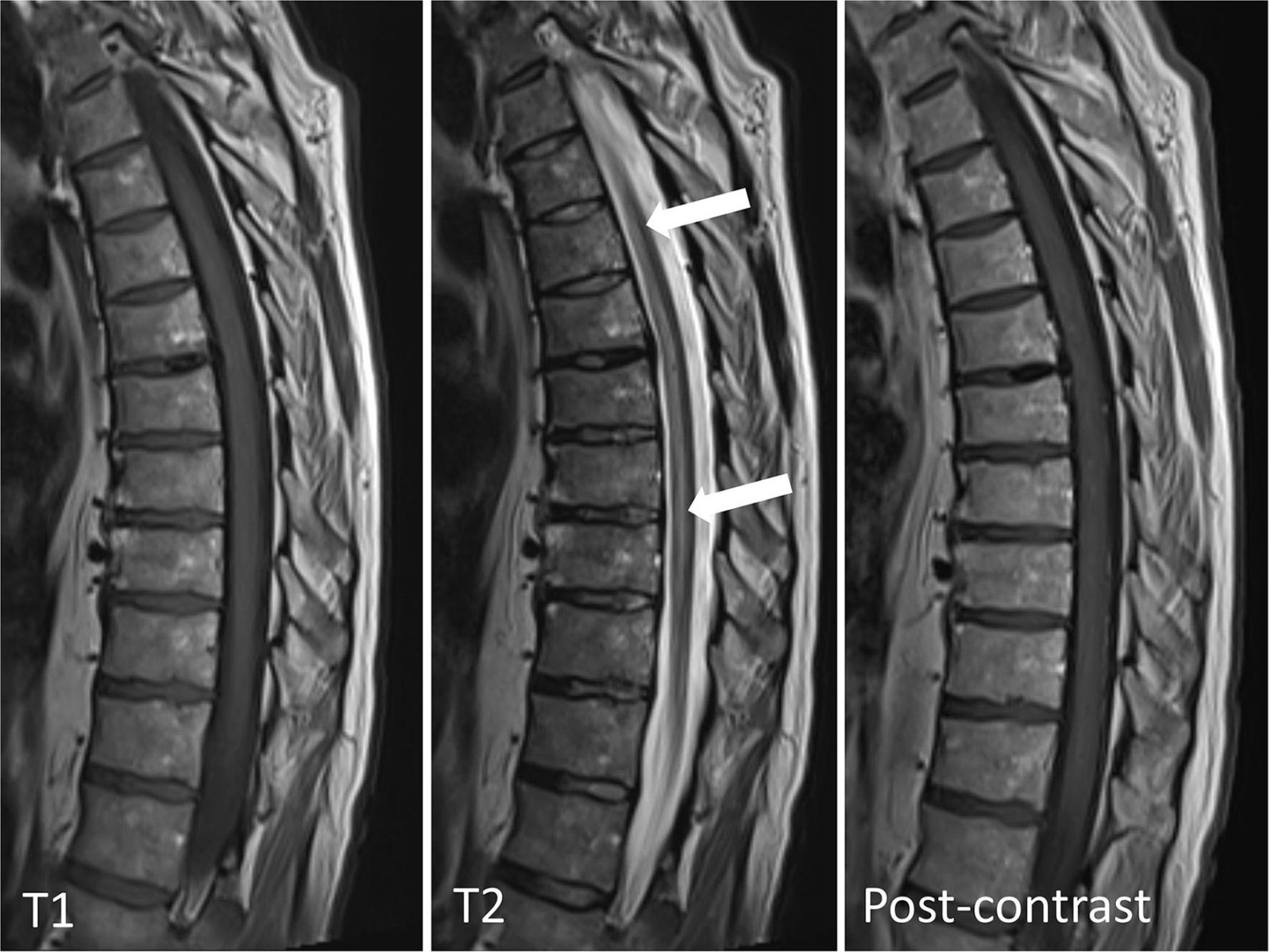
A whole-spine MRI revealed extensive abnormal spinal cord signals extending from the middle thoracic region to the conus medullaris. The imaging included an appearance described as the "Owl's Eyes Sign", involving bilateral signal abnormalities in the anterior horns of the spinal cord. This sign is not specific to Lyme disease, but the imaging demonstrated spinal cord pathology requiring an explanation. [1]
Cerebrospinal fluid testing then supplied decisive evidence of an inflammatory neurological process:
- White blood cells: 349/µL, against a reference value below 4/µL.
- Total protein: 1,810 mg/L, substantially above the laboratory reference range.
- Borrelia antibody index: 5.37, indicating Borrelia-specific antibody production within the central nervous system.
- CXCL13: Above 487 pg/mL, consistent with marked intrathecal inflammation, although this marker is not specific to Lyme disease.
- Additional testing: The investigators reported negative results for numerous alternative infectious and autoimmune causes.
Taken together with the clinical presentation and spinal imaging, these findings supported a diagnosis of late Lyme neuroborreliosis with predominant myelitis. The patient did not recall a tick bite or characteristic Lyme rash and had not previously received treatment for suspected Lyme disease. The diagnosis was not based on vague symptoms or an isolated positive blood antibody test. It rested on neurological abnormalities, spinal cord imaging, inflammatory cerebrospinal fluid findings and evidence of intrathecal Borrelia-specific antibody production. [1]
Why was this considered psychosomatic?
This is arguably the most important question raised by the report. The authors describe a combination of personal psychiatric circumstances, tremor that worsened under stress, and previous brain imaging that had not identified a definitive cause. Those circumstances appear to have influenced the interpretation of her symptoms. But the report does not establish that the patient had a psychosomatic disorder, nor does it demonstrate that psychological factors explained her neurological deterioration.
There is a fundamental difference between observing that a symptom becomes worse during stress and demonstrating that the symptom originates from a psychological process. Tremor variability is not, by itself, evidence that a patient's illness is psychiatric. Likewise, a family history of psychiatric illness does not explain progressive gait dysfunction, bowel and bladder disturbances, or spinal cord inflammation.
The earlier brain scans are particularly relevant. They were not entirely normal, but their abnormalities were considered nonspecific. That uncertainty should not have been transformed into confidence in a psychosomatic explanation. The subsequently documented spinal cord abnormalities demonstrate why the anatomical scope of an investigation matters: two brain MRIs cannot exclude disease affecting the spinal cord.
The central failure was not an inability to recognise a rare disease immediately. It was the apparent willingness to attribute progressive neurological symptoms to psychosomatic causes before the underlying neurological pathology had been identified.
The case report cannot establish exactly when spinal cord abnormalities first became detectable, whether earlier investigations would certainly have established the diagnosis, or how much of the eventual disability could have been prevented. Nevertheless, its authors explicitly identify diagnostic bias and delayed treatment as important concerns. The distinction matters: the criticism is supported by the documented clinical sequence without needing to invent details about individual clinicians' intentions. [1]
Treatment came, but recovery was incomplete
The patient received intravenous ceftriaxone at 2 grams daily for four weeks. Her clinical condition improved, and repeat cerebrospinal fluid testing six months later showed substantial reductions in inflammatory markers. White blood cell counts fell from 349/µL to 12/µL, protein levels declined, and CXCL13 returned below the laboratory threshold. These findings supported a substantial response to treatment.
But the damage was not simply undone. Follow-up spinal imaging still demonstrated abnormal signal changes, and 15 months after treatment the patient continued experiencing fatigue and gait impairment requiring walking aids. The authors discuss the possibility that infection-associated vascular injury contributed to persistent abnormalities, although this mechanism was not definitively established in the patient. [1]
The wider clinical literature recognises that delayed treatment of Lyme neuroborreliosis can be associated with residual neurological problems. This does not prove that every remaining symptom represents ongoing infection, and the case report does not claim that it does. What it documents is an established neurological infection, delayed recognition, objective improvement after antibiotic treatment and continuing disability. [2]
The diagnostic lesson
Late Lyme neuroborreliosis with predominant myelitis is uncommon. Its rarity makes the diagnosis challenging, but rarity is not an excuse for abandoning neurological investigation when symptoms progress and new abnormalities emerge. The relevant question is not whether every patient with dizziness, tremor or fatigue needs a lumbar puncture or spinal MRI. It is whether the evolving clinical picture is being taken seriously enough to reconsider an earlier explanation.
This case is especially relevant to discussions of diagnostic overshadowing. Once symptoms were interpreted through a psychosomatic framework, significant neurological deterioration continued before an infectious and inflammatory explanation was established. The report does not prove that every earlier clinical decision was negligent, but it provides a documented example of the danger of allowing psychiatric context to influence the assessment of potentially serious physical disease.
The authors conclude by calling for careful, unbiased investigation and appropriate diagnostic testing. Their case provides a blunt reminder: a psychosomatic attribution is not a substitute for identifying the cause of progressive neurological signs. When the clinical evidence changes, the diagnosis must be reconsidered. In this patient's case, the eventual answer was not psychosomatic illness. It was late Lyme neuroborreliosis involving the spinal cord.
References
- Duong S, Rudolph N, Majer S. Late Lyme neuroborreliosis with predominant myelitis in a patient with neuropsychiatric presentation: a case report. AME Case Reports. 2025;9:59. DOI | Full text.
- Knudtzen FC, Andersen NS, Jensen TG, et al. Characteristics and Clinical Outcome of Lyme Neuroborreliosis in a High Endemic Area, 1995–2014: A Retrospective Cohort Study in Denmark. Clinical Infectious Diseases. 2017;65:1489–1495. DOI.
- Radzišauskienė D, Urbonienė J, Jasionis A, et al. Clinical and epidemiological features of Lyme neuroborreliosis in adults and factors associated with polyradiculitis, facial palsy and encephalitis or myelitis. Scientific Reports. 2023;13:19881. DOI.
- Kaiser EA, George DK, Rubenstein MN, et al. Lyme myelopathy: Case report and literature review of a rare but treatable disorder. Multiple Sclerosis and Related Disorders. 2019;29:1–6. DOI.