
Clinical Diagnosis: When Medical Inference Becomes “Trust Me, Bro”
 Christoff
Spousal caregiver
A recent discussion on X involving Sam Hall, Recovery in the Bin, Wren and Stigma Buster began with a disagreement about psychiatric diagnoses and the medicalisation of ordinary human distress. It eventually developed into an argument about clinical diagnosis, with epilepsy, migraine, Parkinson's disease and akathisia offered as examples of conditions that do not require a definitive laboratory test to be diagnosed.
The idea that GPs & psychiatrists are rushing to diagnose anything that moves, and people are watching TikTok and thinking yes I'll have some of that 🙄
— Recovery in the Bin (@RITB_) November 11, 2026
Sam questioned whether many psychiatric diagnostic categories have been established as distinct biological diseases, particularly when the distress being diagnosed may have an identifiable external cause. His critics responded that clinical diagnosis is accepted throughout medicine and that demanding objective tests for psychiatric conditions while accepting clinically diagnosed neurological conditions amounts to applying different standards.
That criticism would be reasonable if the argument were simply that conditions without diagnostic biomarkers cannot exist. But questioning the biological validity of a diagnostic category is not the same as denying that patients experience the symptoms used to define it. Nor is questioning the accuracy of a clinical diagnosis equivalent to rejecting clinical diagnosis altogether. These distinctions were repeatedly lost in the exchange, which eventually descended into arguments about artificial intelligence, EEG findings and whether the same standards were being applied to different conditions.
The EEG disagreement illustrates the confusion. Epilepsy can be diagnosed clinically, and a normal routine EEG does not exclude it. Research imaging can also identify group-level differences associated with psychosis, but such findings do not constitute an individually reliable diagnostic test for primary psychotic disorders. The existence of an observable abnormality, the ability to diagnose a clinical presentation and the identification of a distinct underlying disease process are separate questions.
What frustrated me about the discussion was the familiar use of Parkinson's disease as though it were some kind of devastating counterargument. It isn't. I have concerns about the limitations of all clinical diagnoses, including Parkinson's disease. My objection has never been that clinical diagnosis is exclusively a problem in psychiatry or FND. My objection is to the certainty sometimes attached to clinical interpretation, particularly when the evidence supporting that interpretation is limited or its reliability has not been demonstrated.
Parkinson's Disease: The Evidence Doesn't Stop at Observation
Parkinson's disease is primarily diagnosed clinically. Nobody needs to dispute that. But its scientific foundation extends considerably beyond a neurologist observing tremor, rigidity or bradykinesia. Decades of research have identified dopaminergic neurodegeneration, characteristic neuropathological changes in many cases, genetic associations and abnormalities detectable through specialised investigations. More recently, alpha-synuclein biomarkers have provided additional biological evidence, although they cannot independently resolve every diagnostic distinction.
These discoveries do not make Parkinson's diagnoses infallible. In fact, diagnostic uncertainty remains significant enough that modern guidelines emphasise longitudinal assessment and the appropriate use of supporting investigations. Even the biological classification of Parkinson's disease continues to evolve. But that is precisely the point: clinical observations are being investigated against evidence that extends beyond the original clinical description.
There is an important difference between a clinician recognising a presentation and scientists independently establishing what that presentation represents. A clinical diagnosis is an inference drawn from observations. It may be a highly reliable inference, but its reliability must be demonstrated rather than assumed. In that sense, a diagnosis makes a prediction about the condition or process underlying a patient's presentation, and subsequent evidence can support, refine or overturn that prediction.
So when someone responds to concerns about diagnostic validity by pointing out that Parkinson's disease is clinically diagnosed, what exactly have they established? That clinical diagnosis exists? That doctors can recognise patterns? Nobody disputed either point. The relevant question is how the accuracy of that recognition has been established, and whether the clinician's confidence is proportionate to the available evidence.
Parkinson's disease is not exempt from those questions. Neither is epilepsy, migraine, psychiatry or FND. The standard should be consistent, and the limitations should be acknowledged wherever they occur.
When the Textbook Doctor Meets the Real Patient
This is where the discussion becomes considerably more personal, and frankly, where my patience with some of these responses starts running out. Whenever patients raise concerns about diagnostic errors, inadequate investigations or unjustified certainty, some clinicians respond by explaining how the diagnostic process is supposed to work. They describe careful examinations, differential diagnoses, positive clinical signs and the safeguards supposedly built into the process. They then appear satisfied that the criticism has been answered.
Except it hasn't.
I can already imagine a clinician reading this, looking at their own practice and deciding that the criticism is nonsense because they would never behave in the way being described. Perhaps they wouldn't. Perhaps they are exceptionally thorough, understand the limitations of every diagnostic sign they use and carefully investigate relevant alternatives. Good for them. But their personal competence tells me absolutely nothing about the competence of the clinician who examined my wife.
And that is the part I find so infuriating. We are not claiming that every clinician is incompetent or that every diagnosis is wrong. We are pointing out that some clinicians do get things wrong, sometimes badly, and that patients have to live with the consequences. Responding with a description of ideal medical practice does not establish that those standards were followed in the cases being criticised.
It is also not enough to point to the existence of diagnostic safeguards. A safeguard that a clinician does not understand, overlooks or fails to apply offers little protection to the patient sitting in front of them. The question is not whether the framework contains safeguards. It is whether the individual clinician actually used them competently.
And before someone dismisses this as an uninformed complaint, the medical literature itself discusses these problems. Reviews of FND diagnosis identify pitfalls involving weakly positive examination signs, atypical neurological presentations, coexisting disease and premature discontinuation of appropriate investigations. These are not concerns invented by disgruntled patients. They are documented problems acknowledged within neurology itself.
We Were Told 99.9% Certain
During my wife's medical investigations, a neurologist told us he was 99.9% certain she had FND. That is an extraordinary statement, particularly considering that he had already settled on the diagnosis before we even entered the consultation room. FND is supposed to be a clinical diagnosis, established through examination and the identification of positive clinical signs. So how the hell do you arrive at a diagnosis before even examining the patient? What clinical evidence could possibly justify that conclusion, let alone 99.9% certainty? Rather than allowing the evidence to guide him towards a diagnosis, he started with the conclusion and worked backwards. This raises serious questions about confirmation bias and premature diagnostic closure. Was he genuinely evaluating my wife, or simply looking for findings that supported what he had already decided? And if the diagnosis was already settled before the examination, what exactly was the examination supposed to establish?
We subsequently investigated how FND is supposedly diagnosed, including the use of positive clinical signs. None were identified or demonstrated to us during her assessment. Meanwhile, her clear vestibular problems and symptoms suggestive of autonomic dysfunction received little meaningful consideration from a neurologist who appeared unfamiliar with these areas. When we later questioned him about positive FND signs, he seemed equally unfamiliar with those. Somehow, an inability to identify another neurological explanation had become an FND diagnosis, accompanied by near-absolute certainty. The diagnosis was subsequently demonstrated to be wrong.
Yet when experiences like ours are raised, the response from some clinicians is to explain how FND should be diagnosed: positive signs, careful differential diagnosis and appropriate consideration of alternative conditions. What exactly does that establish about the clinician who examined my wife? Am I supposed to congratulate someone else for understanding the guidelines? The existence of a competent diagnostic approach does not mean the clinician sitting across from us actually followed it.
And unfortunately, judging by the numerous patient accounts I've encountered online, our experience is hardly unique. I cannot independently verify every account, nor am I claiming that every reported misdiagnosis is necessarily one. But for those who become angry whenever I share our experience, what exactly am I supposed to conclude? That everyone describing similar encounters is lying? That every clinician involved must have acted competently simply because the diagnostic guidelines say they should? Dismissing these accounts does not address the concerns they raise. It merely avoids having to confront the possibility that the gap between recommended clinical practice and what some patients actually experience is considerably wider than anyone would like to admit.
And where did that 99.9% figure come from? Was it supported by validated diagnostic evidence, or was it simply an expression of personal confidence? There is an enormous difference between believing a diagnosis is correct and demonstrating how reliable that conclusion actually is. A clinician can be exceptionally confident and exceptionally wrong. Without evidence supporting that degree of certainty, 99.9% is little more than personal conviction dressed up as mathematical precision.
Disease in the Eye of the Beholder
There is another aspect of clinical diagnosis that troubles me. When a clinician concludes that a presentation does not fit any known neurological disease, the reliability of that conclusion depends heavily on the clinician's knowledge of the diseases supposedly being considered. And that is an enormous burden to place on any individual. Neurology encompasses hundreds of conditions, including rare disorders, atypical presentations and diseases that may take years to become clinically recognisable. No neurologist, however experienced, can reasonably be expected to know every condition, recognise every variation or remain familiar with every development in medical research.
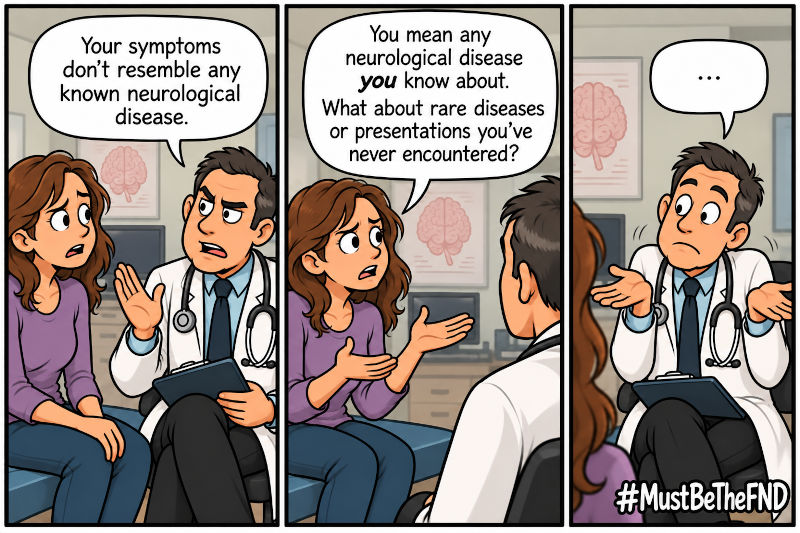
That is not a criticism of clinicians. It is an acknowledgement that they are human. What I struggle with is the apparent reluctance of some to acknowledge those limitations themselves. There should be considerably more humility involved in making a statement as sweeping as "this does not fit any known neurological disease." How can an individual clinician confidently make that determination when the range of possible conditions extends beyond what any one person could reasonably know? Surely there is a difference between having sufficient expertise to identify the most likely explanation and possessing enough knowledge to confidently dismiss every other plausible one.
The burden of making such a claim should not be underestimated. It requires more than familiarity with common neurological conditions or recognising that a presentation does not resemble something encountered in everyday practice. It requires an appreciation of rare diseases, incomplete presentations, diagnostic limitations and, perhaps most importantly, the possibility that the clinician simply does not know. Medicine is an enormous and constantly evolving field. Not recognising a condition is not evidence that the condition does not exist, nor that it cannot explain the patient's symptoms.
In other words, the patient is being asked to trust that the clinician knows enough to recognise what does and does not fit. But what happens when that clinician has already demonstrated gaps in their knowledge or questionable reasoning? Why should their inability to identify an alternative explanation be treated as evidence that no such explanation exists? And why is acknowledging the limits of one's knowledge sometimes treated as less acceptable than expressing certainty that may not be justified?
There is a fundamental difference between "I cannot identify a neurological disease that explains this presentation" and "No neurological disease explains this presentation."
The first statement demonstrates intellectual humility. The second risks turning the limits of an individual's knowledge into a supposed limit of medical possibility. I would have considerably more confidence in a clinician willing to say "I don't know" than one who presents their inability to recognise an explanation as proof that no alternative exists. Recognising the limits of one's expertise is not a weakness. Pretending those limits do not exist is.
What troubles me most is that, in my wife's case, an apparent inability to identify another neurological explanation somehow became an FND diagnosis expressed with 99.9% certainty. At what point did not knowing become knowing?
And yes, I am aware that contemporary FND literature advocates diagnosis through positive clinical signs rather than simply excluding other diseases. Repeating that fact does not answer the criticism. Those signs still require competent examination and interpretation, and the evidence supporting individual signs varies. A 2025 review of positive FND signs explicitly acknowledges that no single sign is pathognomonic and that the supporting evidence is inconsistent across different findings.
Other publications warn that weakly positive signs can lack specificity, that unusual neurological presentations should not automatically be classified as FND and that neurological disease may coexist with an FND diagnosis. These limitations matter because the interpretation of a clinical sign is not independent of the person interpreting it.
This is what I mean by disease in the eye of the beholder. When a diagnostic conclusion depends heavily on a clinician's interpretation, and that interpretation is subsequently treated as though it establishes the underlying explanation, the distinction between observation and demonstrated disease can become dangerously blurred.
The patient may have a recognisable clinical presentation. That does not automatically establish that the clinician has correctly identified its cause, excluded relevant alternatives or demonstrated that the presentation represents one distinct disease process.
Stop Defending the Ideal and Address the Reality
What I find most exhausting is how easily criticism of diagnostic practice gets redirected into an argument nobody was making. Question the reliability of a clinical diagnosis and someone brings up Parkinson's disease. Question the certainty attached to FND and someone explains positive signs. Describe an experience involving questionable clinical competence and someone responds with how a competent neurologist would have approached the case.
None of those responses establishes that the clinician being criticised was correct.
There is a difference between defending clinical diagnosis as a legitimate medical method and defending every conclusion reached through that method. The former can be reasonable. The latter requires evidence about the individual assessment, not a lecture about what doctors are trained to do.
Some clinicians and FND proponents seem more concerned with defending the diagnosis than the patients themselves, often under the guise of patient advocacy. When patients raise legitimate concerns about how their diagnosis was reached, the response is too often a defence of the diagnostic framework rather than an examination of what actually happened. Nobody is questioning whether competent clinicians exist. The question is whether the particular clinician involved acted competently, whether the evidence justified the diagnosis and whether the certainty expressed was warranted. Defending how FND should be diagnosed does nothing to address how it was diagnosed. And dismissing patients who raise those concerns while claiming to advocate for them raises an obvious question: whose interests are actually being protected?
Here we go again 🤦♀️. Another article from @DrDavidHealy questioning Functional Neurological Disorder. Meanwhile, let’s pretend #FND patients don’t exist and warrant a place in the debate. You know, including those who’ve never taken SSRIs. Round two. 🧵 pic.twitter.com/QlENUIHDDy
— KimH (@KH118118) October 28, 2026
And if your response to that is simply that you personally would never make such a mistake, then you have missed the point entirely. Your own standards do not erase the mistakes of others. Your familiarity with the literature does not establish that another clinician understood it. Your confidence in the diagnostic framework does not demonstrate that it was correctly applied.
Clinical diagnosis is not inherently worthless, but neither is it beyond criticism. It is a method of reasoning under uncertainty, performed by fallible human beings. Sometimes that reasoning is supported by extensive independent evidence. Sometimes it is not. Sometimes the clinician is competent and thorough. Sometimes they are not. And sometimes the certainty expressed bears little resemblance to what the evidence can actually establish.
Patients are entitled to question those differences without being accused of denying the existence of disease, rejecting medicine or failing to understand clinical diagnosis.
So please, spare me another explanation of how a competent neurologist is supposed to diagnose a patient. I am interested in whether the clinician who actually examined my wife did so competently, what evidence supported the conclusion and why we were given a figure of 99.9% certainty.
Until those questions can be answered, appeals to clinical authority amount to little more than an elaborate version of "trust me, bro."
References
- National Institute of Neurological Disorders and Stroke — Parkinson's Disease. Overview of clinical diagnosis, genetics, imaging and emerging biomarkers.
- The Clinical Diagnosis of Parkinson's Disease (2024). Reviews clinical diagnostic criteria, differential diagnosis and supporting investigations.
- Definition and Diagnosis of Parkinson's Disease: German Society of Neurology Guideline (2024). Addresses diagnostic accuracy, longitudinal follow-up and biological evidence.
- Cautionary Notes on Diagnosing Functional Neurologic Disorder as a Neurologist-in-Training (2021). Discusses diagnostic pitfalls, specificity limitations and neurological comorbidity.
- A Practical Review of Functional Neurological Disorder for the General Physician (2021). Discusses positive signs, diagnostic reasoning and recognised errors in clinical practice.
- Positive Clinical Signs in Functional Neurological Disorders: A Narrative Review (2025). Reviews the limitations, specificity and evidence supporting positive clinical signs.
- Functional Neurological Disorder: Diagnostic Pitfalls and Differential Diagnostic Considerations (2023). Discusses clinical reasoning and the importance of appropriate differential diagnosis.