
Genetic Testing Can Miss Rare Neurological Diseases: European Experts Expose Diagnostic Gaps
 FND Nope
Moderator
Imagine spending years searching for an explanation for unexplained neurological symptoms, undergoing genetic testing, and being told the results are negative. You might reasonably assume that a genetic disease has been ruled out. But what if the test never looked for the particular abnormality causing your symptoms, or the laboratory simply could not detect it?
In July 2026, a group of European experts published new recommendations for genetic testing in rare neurological diseases in the European Journal of Human Genetics. Their work identified significant differences in how laboratories conduct genetic investigations, interpret results and report their findings. The recommendations were developed by 31 experts from 11 European countries and endorsed by the European Academy of Neurology.
The researchers were not announcing a new genetic test or a newly discovered disease. They were addressing weaknesses in tests already being used to diagnose neurological conditions. Their review of laboratory quality assessments revealed enough inconsistencies to justify 27 recommendations aimed at improving reliability and accuracy.
The implications are straightforward. Genetic testing is powerful, but a negative result does not always mean that a genetic neurological disease has been excluded. It may mean that the particular test did not find anything it was capable of identifying.
What can genetic testing miss?
Not all genetic tests look for the same things. Some examine a relatively small selection of genes associated with suspected conditions, while others examine much larger portions of a person's DNA. Even the more comprehensive tests have limitations, and certain genetic abnormalities require specialised methods to detect.
Another problem is that medical knowledge keeps changing. Researchers continue to discover genetic causes of neurological diseases, meaning a test performed several years ago may not have included genes that are now known to be important. Previously unexplained results can sometimes become meaningful when existing genetic data are examined again using newer knowledge.
The European experts also found that laboratories do not always use the same methods or interpret findings consistently. Two patients undergoing what sounds like the same genetic investigation may not necessarily receive testing with identical capabilities. This is why the researchers want clearer standards, better reporting and more consistent interpretation of results.
For patients, the distinction matters. Being told that a genetic test was negative is not the same as being told that every possible genetic explanation has been excluded. Doctors need to understand exactly what the investigation was capable of finding before deciding what its results mean.
Rare neurological diseases do not always look familiar
There is another problem that genetic testing alone cannot solve. Rare neurological diseases may produce symptoms that a clinician has never encountered before, or combinations of symptoms that do not fit a familiar diagnosis. Some cause unusual movements, muscle stiffness, tremors, weakness, balance problems or difficulty walking. Others progress slowly, fluctuate or affect several parts of the nervous system.
Conditions such as hereditary dystonia, genetic ataxias and hereditary spastic paraplegia illustrate this difficulty. These are established neurological diseases with identifiable genetic causes in many cases, yet their symptoms can vary considerably between patients. Some people develop severe walking difficulties, others experience involuntary movements, and some have unusual combinations of symptoms that make the underlying disease harder to recognise.
One particularly interesting example is dopa-responsive dystonia, a condition that can cause abnormal movements, stiffness and walking difficulties that worsen at certain times of the day. Some forms respond remarkably well to a medication called levodopa. A patient's ability to move better at one time and worse at another does not automatically make the symptoms psychological or functional. Fluctuation can be part of an established neurological disease.
This is also relevant to functional neurological disorder (FND). Symptoms commonly associated with FND, including weakness, tremors, unusual movements and walking difficulties, can overlap with those of rare neurological diseases. A clinician may not immediately recognise an uncommon genetic condition, particularly when the patient does not present with the expected textbook symptoms.
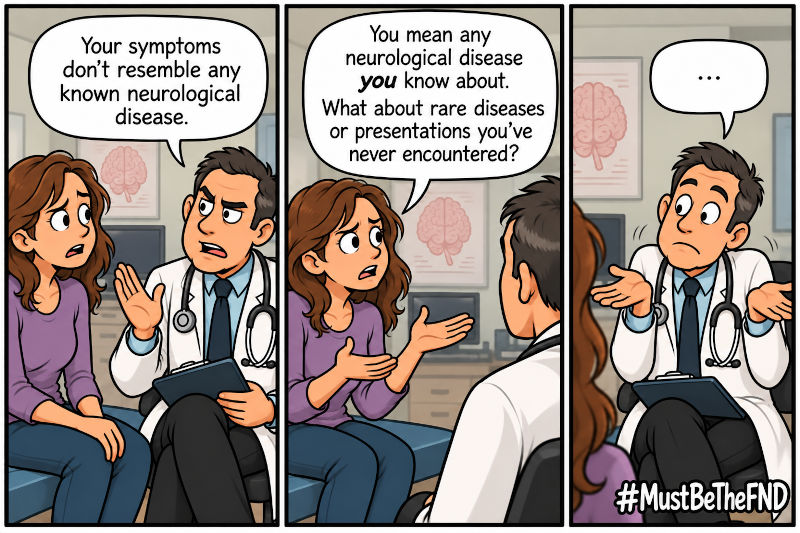
There is an important difference between a disease not fitting a recognised pattern and a disease not existing. A neurologist's unfamiliarity with a rare condition does not make the patient's symptoms functional. Equally, an unusual presentation alone does not establish that a genetic disease is present. It means the clinical findings deserve careful interpretation rather than assumptions based on what is familiar.
The European study did not investigate FND or establish how often genetic neurological diseases are mistaken for it. The connection is that some of these diseases can produce overlapping symptoms, while the study demonstrates that the genetic investigations used to identify them have recognised limitations.
Not recognising a neurological disease is not the same as ruling one out. Sometimes the problem is not that the patient's symptoms make no sense, but that the explanation has not yet been found.
Even the experts disagreed about who should be tested
Perhaps the most revealing part of the research was the one issue the experts could not agree on: which patients should qualify for genetic testing.
Some argued that extensive genetic investigations should mainly be offered when there are strong reasons to suspect an inherited disorder, such as symptoms beginning early in life, a family history or an unusual combination of neurological problems. Others supported making broader genetic testing available earlier in the diagnostic process.
Both approaches have consequences. Restricting testing can help avoid unnecessary investigations, but patients with rare or unfamiliar presentations may never receive the test that could identify their condition. Broader testing may uncover additional diagnoses, although it also brings costs and results that can be difficult to interpret.
The panel agreed on 27 of its 28 proposed recommendations but could not reach consensus on this question. That is significant. Even among specialists working to improve genetic diagnosis, there is disagreement about how widely these investigations should be offered.
For readers who want the technical details
This section explains some of the testing methods and limitations discussed in the research. Readers interested mainly in the findings can skip to the conclusion.
- Next-generation sequencing (NGS): Technology that allows laboratories to examine large amounts of DNA for genetic changes associated with disease.
- Whole-exome sequencing (WES): Examines mainly the protein-coding portions of genes, where many known disease-causing variants occur. It does not cover the entire genome.
- Whole-genome sequencing (WGS): Examines a much broader portion of a person's DNA. Although more comprehensive, it still has technical limitations and does not guarantee detection of every genetic disorder.
- Gene panels: Tests targeting selected genes associated with particular conditions. Panels can become outdated as new disease-associated genes are discovered.
- Repeat expansions: Genetic abnormalities caused by sections of DNA being repeated too many times. These occur in certain neurological disorders, including some hereditary ataxias, and may require specialised detection methods.
- Structural variants: Larger changes to DNA, such as missing, duplicated or rearranged sections. Some are difficult to identify using particular sequencing methods.
- Variants of uncertain significance: Genetic changes whose relationship to disease is not yet established. Finding one does not automatically mean it explains a patient's symptoms.
- Genomic reanalysis: Re-examining existing genetic data using updated scientific knowledge or improved analysis methods. This can sometimes produce diagnoses that were not possible when the data were first examined.
The researchers recommended improvements in all these areas, including regular updates to gene panels, clearer reporting of what tests cannot detect, minimum quality standards and better sharing of information about genetic variants between laboratories.
The paper also references research published in Nature Medicine showing that reanalysing genetic data from previously unresolved rare-disease cases can lead to additional diagnoses. In other words, genetic information that did not provide an answer originally may become useful as medical knowledge advances.
What this means for patients
The most practical lesson is that patients and clinicians should know what a genetic investigation actually covered. Was it a limited test looking for a handful of suspected conditions, or a broader examination? Were there genetic abnormalities it could not reliably detect? Has new research emerged since the original testing? Would further investigation be justified by the patient's symptoms and clinical findings?
These questions become particularly important when symptoms are progressing, new neurological problems appear, or the original diagnosis does not adequately explain the clinical picture. An earlier negative result may still be valuable, but it should be interpreted within the limits of the investigation rather than treated as an absolute answer.
The 2026 recommendations do not prove that large numbers of neurological patients have been misdiagnosed, nor do they establish that everyone with unexplained symptoms needs whole-genome sequencing. They identify real weaknesses in the diagnostic process and propose ways to address them. Whether those improvements lead to better outcomes will need to be assessed as laboratories adopt the recommendations.
For patients living with rare neurological diseases, the stakes are considerable. A correct diagnosis can affect treatment decisions, access to specialist care, monitoring and the ability of family members to understand their own genetic risks. Some conditions have specific treatments, while others may benefit from better management once their underlying cause is recognised.
A negative genetic test is not a guarantee that no genetic disease exists. And an unfamiliar neurological presentation is not proof that there is no neurological explanation. The limits of a test, or of a clinician's knowledge, should never be confused with the limits of what might actually be wrong.
References
- Maver A, et al. (2026). Consensus recommendations for next-generation sequencing-based genetic testing in Rare Neurological diseases. European Journal of Human Genetics.
- Maver A, et al. (2024). Quality assurance for next-generation sequencing diagnostics of rare neurological diseases in the European Reference Network. European Journal of Human Genetics.
- Ibañez K, et al. (2022). Whole genome sequencing for the diagnosis of neurological repeat expansion disorders in the UK. The Lancet Neurology.
- Laurie S, et al. (2025). Genomic reanalysis of a pan-European rare-disease resource yields new diagnoses. Nature Medicine.
- Weissbach A, et al. (2022). Relationship of Genotype, Phenotype, and Treatment in Dopa-Responsive Dystonia: MDSGene Review. Movement Disorders.
- Ramakrishnan S, et al. (2025). Unraveling Isoform Complexity: The Roles of M1- and M87-Spastin in Spastic Paraplegia 4 (SPG4). Movement Disorders.
- Seong E, et al. (2018). Mutations in VPS13D lead to a new recessive ataxia with spasticity and mitochondrial defects. Annals of Neurology.
This hits close to home. My wife has an extremely high foot arch (pes cavus), a physical feature often associated with Charcot-Marie-Tooth disease (CMT). We had genetic testing done, and the results came back normal. The catch? Only four genetic variants were tested, despite CMT being associated with over 100 different genes. Differential Diagnosis: Charcot-Marie-Tooth (CMT)
We're not saying she has CMT, but surely testing four variants doesn't rule it out? It makes me wonder how many patients are told their results are "normal" without realising how limited the testing actually was.