
When a 50-Minute Seizure Becomes “Textbook FND”: Diagnostic Certainty Without Evidence

A woman reportedly experienced a seizure-like episode lasting approximately 50 minutes, followed by profound memory loss. According to her caregiver, she no longer recognizes herself or others and believes it is 2006. The caregiver suspects Long COVID may be involved.
It's a disturbing account, with plenty of unanswered questions. Fortunately, someone holding a Doctor of Physical Therapy (DPT) qualification appears to have solved the mystery without the inconvenience of examining the patient.
The only possible explanation for a 50 minute seizure is a functional seizure. What she describes is textbook FND and has nothing to do with “long Covid”. Hope this helps.
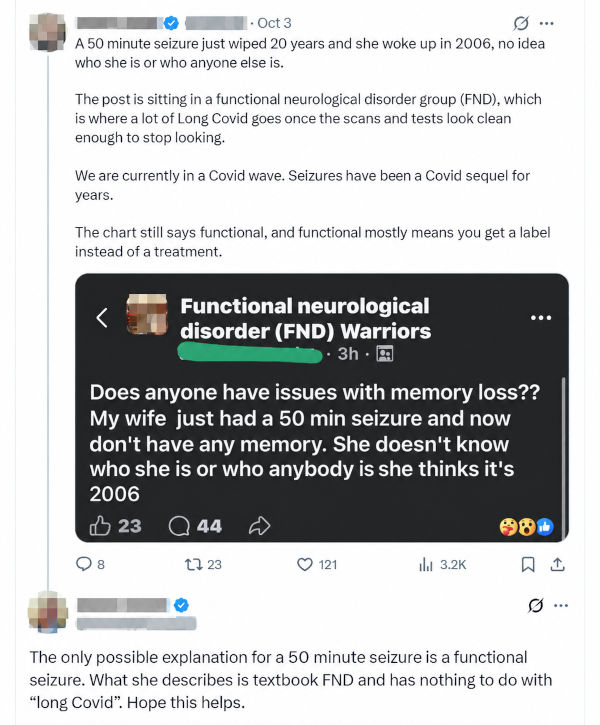
Well, that's a relief. Neurology has apparently been reduced to a stopwatch and a comment section. Someone should tell the hospitals. Think of the savings.
The phrase worth examining is "the only possible explanation." Not a possibility, not a suspicion, but an absolute exclusion of every alternative. Quite an achievement considering the available information consists of a second-hand social media account, with no documented neurological examination, EEG findings, clinical history or meaningful differential diagnosis.
And there's a rather awkward problem: the medical literature.
Fifty Minutes? Someone Forgot to Tell Epilepsy.
In 2015, the International League Against Epilepsy (ILAE) published its revised definition and classification of status epilepticus. For convulsive status epilepticus, approximately five minutes of continuous seizure activity is the operational threshold for urgent treatment. At approximately 30 minutes, the risk of long-term neurological consequences becomes particularly concerning.
These thresholds exist precisely because epileptic seizures can continue beyond their usual duration. Prolonged epileptic activity is not an imaginary phenomenon invented to inconvenience confident social media commentators. It is a recognized neurological emergency, described in the ILAE's published definition of status epilepticus.
| Duration | Clinical significance | Reference |
|---|---|---|
| 5 minutes | Operational threshold for treating ongoing convulsive seizure activity as status epilepticus. | ILAE, 2015 |
| 30 minutes | ILAE threshold associated with the risk of long-term consequences from ongoing convulsive status epilepticus. | ILAE, 2015 |
| 50 minutes | The duration reported in this case. Duration alone cannot establish whether the event was epileptic or functional. | Xue & Reuber, 2026 |
| Hours or longer | Prolonged epileptic status can continue or recur despite treatment, including refractory and super-refractory presentations. | Clinical review, 2020 |
| Days to weeks | Severe refractory and super-refractory status epilepticus can involve prolonged or recurrent epileptic activity requiring intensive treatment. | NCBI Bookshelf |
These entries describe different clinical concepts, not uninterrupted visible convulsions of equivalent duration. Status epilepticus may involve continuous or recurrent electrical seizure activity, and treatment can extend well beyond the visible manifestations. Nevertheless, the central point survives this distinction quite comfortably: epilepsy does not become impossible at the 50-minute mark.
In July 2026, Qing Xue and Markus Reuber published a systematic review examining seizure duration in functional and epileptic seizures, covering 45 studies. They found that functional seizures often last longer than typical epileptic seizures, but no single duration threshold reliably distinguishes the two.
So even the research specifically investigating this question declines to make the claim that our social media expert delivered in a few keystrokes. Perhaps the researchers should have checked the comments before wasting their time on 45 studies.
Then there is the reported memory loss. A woman allegedly unable to recognize herself or others, believing she is living decades in the past, presents a serious clinical problem. Postictal disturbances, ongoing seizure activity, metabolic abnormalities and other neurological explanations may need consideration. The precise cause cannot be determined from the account, which is exactly why an exclusive diagnosis is such an extraordinary thing to announce.
Textbook FND? Which Textbook? Which Page?
Perhaps the caregiver is wrong about Long COVID. Entirely possible. But dismissing one speculative explanation does not automatically validate another. That's not differential diagnosis; that's playing medical musical chairs and declaring victory when the music stops.
What makes this presentation "textbook FND", exactly? The duration? The memory loss? The absence of information? We have no documented seizure semiology, no examination findings, no EEG results and no established positive signs. We don't even know whether the reported 50 minutes describes one continuous event, repeated episodes or an approximate recollection of a complicated incident.
Yet the diagnosis is presented as though the patient arrived with an instruction manual and a label already attached.
The American Academy of Neurology's functional seizure practice guideline discusses the importance of patient and witness histories, seizure characteristics, available video and EEG findings, and video-EEG when appropriate. In other words, actual clinical evidence. A surprisingly old-fashioned concept.
There is a substantial difference between saying a presentation raises suspicion of functional seizures and announcing that no other explanation is possible. The former is a clinical hypothesis. The latter is a conclusion requiring evidence that has not been provided.
"Textbook" is not a positive diagnostic sign. Neither is confidence.
There seems to be a remarkably convenient pattern of reasoning here: if a symptom is unusual, unfamiliar, or doesn't fit the commentator's expectations, it must be functional. A 50-minute seizure? Functional. Profound memory loss? Apparently textbook FND. No examination, EEG, or documented positive signs? Evidently no obstacle. This is diagnosis by incredulity, where the inability to imagine another explanation is mistaken for evidence that no other explanation exists. The patient's symptoms become proof of FND simply because the commentator finds them difficult to explain. It's a fascinating approach to medicine: the less you know about the case, the more certain you can apparently become.
Doctorate in Physical Therapy. Apparently a Minor in Omniscience.
The commentator holds a Doctor of Physical Therapy qualification. That is a legitimate doctoral-level healthcare qualification, but it is not a medical degree in neurology or epilepsy. Physical therapists are trained in clinical reasoning, neurological screening and recognizing circumstances requiring further medical evaluation.
The Commission on Accreditation in Physical Therapy Education's standards crosswalk includes neurological examination, clinical judgment and determining when referral or further investigation is appropriate.
Nobody expects a physical therapist to diagnose every neurological condition. In fact, nobody should be diagnosing this particular woman from a short social media description. The concern is that someone with healthcare training has confidently excluded neurological possibilities without presenting the evidence necessary to exclude them.
The professional's exact regulatory scope depends on jurisdiction, and this comment alone does not establish professional misconduct. But it is perfectly reasonable to criticize the quality of the medical claim. The same criticism would apply to a neurologist, a professor or the Pope wearing a stethoscope. The ILAE definition does not change depending on who is holding the keyboard.
And here is the particularly embarrassing part. Someone without medical training can open the publicly available literature, read the definition of status epilepticus and discover that prolonged epileptic seizures exist. No doctorate required. Apparently, access to PubMed is less exclusive than access to certainty.
That doesn't make the layperson a neurologist. It simply means the professional's categorical assertion fails a rather basic fact-check. A credential is supposed to indicate expertise, not serve as a decorative shield against elementary questions.
Even FND Connect seems to have heard of status epilepticus. Their own seizure alert card advises calling emergency services when a seizure lasts longer than five minutes. Meanwhile, our DPT confidently announces that a 50-minute seizure can only be functional. Apparently, the people printing FND alert cards know something our self-appointed seizure expert doesn't. Still, I'm not sure I'd want a card hanging around my neck announcing that I don't usually need medical help during seizures. Particularly with professionals like this running around. Perhaps someone should send him a card too. Preferably with the emergency instructions facing forward.

See the danger? If he's wrong, a potentially life-threatening epileptic emergency could be dismissed as FND. Bad diagnostic reasoning combined with advice not to seek medical help can have deadly consequences.
Diagnosis by Wi-Fi
What this exchange demonstrates is premature diagnostic closure: reaching a conclusion before sufficient information has been gathered or reasonable alternatives have been considered. It is particularly troubling when the conclusion is delivered publicly under professional authority, because patients and caregivers may mistake confidence for clinical reliability.
A reported 50-minute seizure-like episode with profound cognitive disturbance warrants serious medical assessment. If convulsive seizure activity is ongoing for five minutes or more, emergency treatment is indicated. That is the clinical significance of prolonged seizures, not an invitation to declare epilepsy impossible from a distance.
We do not know the woman's diagnosis. It could ultimately involve epilepsy, functional seizures or another condition entirely. The caregiver may be mistaken about Long COVID. None of those possibilities changes the problem with the comment: the available evidence does not support the claim that there is only one possible explanation.
Medicine is supposed to distinguish between what is known, what is suspected and what remains uncertain. When those distinctions disappear, the result may sound impressively authoritative, but it is still guesswork. Adding "textbook" merely gives the guess a little academic perfume.
Patients deserve investigations, not performances of certainty. And healthcare professionals making absolute claims in public should expect people to check whether the textbooks agree.
As it turns out, the most textbook thing about this exchange may be the premature diagnostic closure.
Hope this helps.
References
- Trinka E, et al. (2015). A definition and classification of status epilepticus — Report of the ILAE Task Force.
- Xue Q, Reuber M. (2026). Seizure duration in functional/dissociative seizures: measurement, variability and diagnostic significance.
- Diagnosis and Treatment of Status Epilepticus (2020).
- Modern Treatment of Status Epilepticus in Adults. NCBI Bookshelf.
- American Academy of Neurology. Management of Functional Seizures Practice Guideline Executive Summary.
- Commission on Accreditation in Physical Therapy Education. Physical Therapist Education Program Accreditation Standards Crosswalk.
Please note: This post discusses an account shared publicly on social media. The person's medical history and diagnosis have not been independently verified. We report what they said and link to the original source where possible.