
The Weaponization of FND: Selma Blair, MS, and Hysteria With Better Branding

Selma Blair spent decades experiencing unexplained medical symptoms before being diagnosed with multiple sclerosis (MS) in 2018. The actress, known for Cruel Intentions and Legally Blonde, has described neurological difficulties dating back to childhood, including pain, visual disturbances, fatigue and bladder problems. Her medical history, eventual diagnosis and subsequent treatment have been discussed publicly, including in her memoir Mean Baby and the 2021 documentary Introducing, Selma Blair.
In a PBS interview, Blair described seeking medical answers from childhood and the experience of having symptoms repeatedly dismissed. Her story should be a reminder of what can happen when clinicians fail to adequately investigate patients. Instead, it has become an opportunity for an FND-focused allied healthcare professional to publicly question her honesty and medical history.
And this is where things become particularly ugly: functional neurological disorder (FND), a diagnosis supposedly modernised to reduce the stigma associated with hysteria, is being used as a weapon against someone diagnosed with another neurological disease. Not to explain symptoms through an appropriate clinical assessment, but as part of an accusation that a woman is exploiting her illness for sympathy and special treatment. Quite a remarkable achievement for a diagnostic framework promoted as more compassionate and patient-centred.
Here is what the professional wrote:
"Selma keeps using this narrative that she has multiple sclerosis to receive sympathy & special treatment…"
"You cannot have MS since childhood (as she claims), receive no treatment for decades, and then have zero physical deficits!"
"She was highly symptomatic in her documentary and her symptoms are textbook FND."
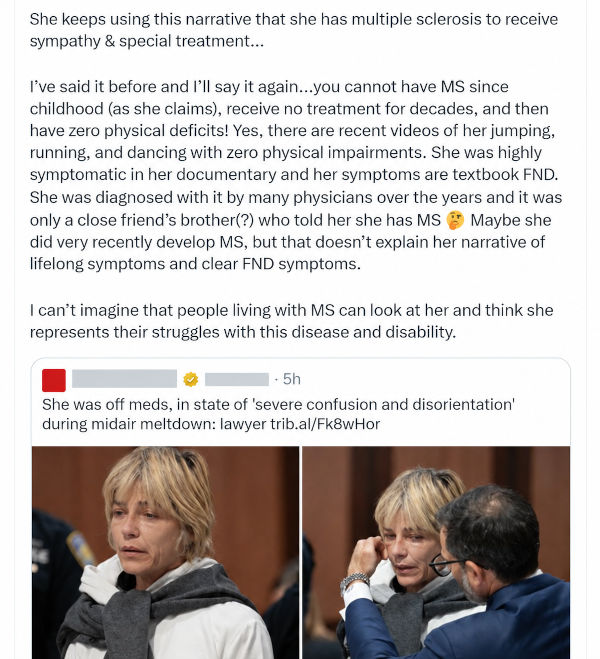
That is not merely questioning when Blair's MS began. It is publicly suggesting that she uses her medical history for personal benefit. He does not explicitly accuse her of fabricating medical records, but the implications are serious. Blair's diagnosis, treatment and medical experiences have been publicly documented. If he believes she is knowingly misleading people, what exactly does he think is false? Her account of childhood symptoms? The clinical interpretation of those symptoms? The diagnosis itself? Or does he simply believe that his interpretation of her documentary carries more weight than the medical professionals who actually examined her?
Accusing someone of exploiting illness for sympathy is not a minor disagreement about diagnostic criteria. It is an allegation about character and motive. Coming from a healthcare professional, it carries an implied authority that makes the absence of supporting evidence particularly troubling. Confidence is not evidence, and a professional qualification does not magically transform speculation into fact.
His apparent smoking gun is that Blair has been seen running, jumping and dancing without obvious physical impairment. Apparently, neurology has finally found a cheaper alternative to clinical examinations and MRI scanners: watch a few videos and check whether the patient can dance. Perhaps the next diagnostic guideline should include a compulsory TikTok performance.
Multiple sclerosis can involve fluctuating symptoms, remission and periods without obvious disability. Reporting symptoms since childhood does not mean claiming uninterrupted, progressive physical impairment since childhood. And the ability to perform an activity in a video tells us remarkably little about someone's neurological condition at other times. For someone speaking with such certainty, these are rather important distinctions to overlook.
The irony is that FND advocates regularly insist that symptoms can fluctuate, that patients may have good days and bad days, and that visible physical ability does not establish dishonesty. Yet those principles apparently become optional when discussing someone with MS. A patient diagnosed with FND can dance without invalidating their symptoms, but when Blair dances, it becomes evidence against her. Apparently, the rules of neurological disability change depending on which diagnosis the professional prefers. Fascinating medicine.
Then comes the functional explanation. The professional concedes that Blair might have developed MS more recently, but insists that her earlier symptoms were textbook FND. Based on what? Where are the positive clinical signs, the examination findings or the evidence separating those symptoms from MS or another possible cause? A documentary can show symptoms, but it cannot establish their underlying mechanism. Otherwise, medical schools could replace clinical rotations with Netflix.
This resembles the diagnostic rigidity we have examined in our discussion of the common phenotypes hypothesis. When another neurological condition enters the picture, an earlier functional interpretation should remain open to reconsideration. If the diagnosis survives every possible competing explanation without requiring fresh evidence, one begins to wonder whether it is being evaluated or merely protected.
And that brings us to the historical problem. For generations, patients, particularly women, had symptoms interpreted through assumptions about their emotions, personalities and credibility under the broad umbrella of hysteria. Modern FND may use different diagnostic terminology, but the resemblance becomes difficult to ignore when a healthcare professional invokes a functional explanation while suggesting that a woman with MS is seeking sympathy.
Hysteria was supposed to have retired. Instead, some of its worst habits appear to have acquired a new nameplate and a social media account.
There is another rather extraordinary layer of hypocrisy here. This same professional previously threatened the creator of this website with legal action over a cartoon he believed resembled and misrepresented him. A cartoon. Apparently, perceived misrepresentation in a drawing was serious enough to warrant legal threats, while publicly suggesting that a woman diagnosed with MS exploits her illness for sympathy is acceptable commentary. Perhaps a mirror would be more useful than another legal consultation.
We follow professionals working in the FND environment to understand their perspectives, clinical reasoning and responses to criticism. Agreement is not expected. But watching this particular account has become increasingly concerning. This is not merely about someone posting ridiculous opinions online. It is about someone working in a healthcare environment where patients may be vulnerable, frightened, medically complex and dependent on professionals exercising sound judgment. If this is how a professional publicly reasons about someone else's medical history, what confidence should patients have that their own symptoms will be approached with appropriate humility and care?
It would be tempting to describe the behaviour as a caricature of diagnostic arrogance, except caricatures are supposed to exaggerate reality. Here, satire is struggling to keep up. The apparent determination to preserve FND as the explanation resembles a toddler refusing to surrender a favourite toy. Unfortunately, patients are not toys, and diagnoses are not personal possessions. A diagnosis exists to serve the patient, not to protect a professional's investment in being right.
We have documented the consequences of premature functional explanations elsewhere on this website, including Emma's story, in which an initial FND diagnosis preceded the recognition of another serious neurological condition. The circumstances differ, but the broader concern is familiar: what happens when a preferred diagnosis becomes more important than investigating the patient?
Which raises an uncomfortable question for Jon Stone and other influential figures involved in shaping modern FND practice. Is this what they envisioned? A supposedly patient-centred clinical culture in which professionals publicly accuse people with other neurological diagnoses of seeking sympathy, scrutinise videos for signs of insufficient disability and confidently assign functional explanations without presenting clinical evidence? There is no reason to assume Stone endorses these statements, but if such behaviour contradicts the standards promoted by FND advocates, where is the professional pushback? What exactly are the standards, and who is expected to uphold them?
We are increasingly struggling to take this particular professional seriously. His statements also raise legitimate questions about professional accountability. At what point does publicly questioning a patient's honesty while making unsupported diagnostic assertions become a matter for a licensing or professional board? Whether these comments breach any particular professional standard would require assessment, and our confidence in medical boards providing meaningful accountability is limited. But that does not make the question irrelevant.
Blair does not have to prove her illness to a healthcare professional commenting on social media. Questioning medical claims is legitimate; suggesting that someone exploits a disease for sympathy requires evidence. And declaring symptoms textbook FND from documentary footage does not transform speculation into a clinical finding, regardless of the commentator's professional qualifications.
If this is how a supposedly stigma-reducing diagnosis can be used against a woman with a publicly documented MS diagnosis, what chance does an ordinary patient have when a healthcare professional decides that their symptoms are functional and refuses to reconsider?
We were promised a departure from hysteria. What we are seeing here looks suspiciously like hysteria returning from holiday with a new business card.
References and further reading
- PBS: Selma Blair — Interview discussing her childhood symptoms and MS diagnosis.
- The Guardian: Selma Blair on living with MS — Blair's medical history and experiences with delayed diagnosis.
- National Multiple Sclerosis Society: What Is MS? — Background on MS and its variable clinical course.
- FND NOPE: The Common Phenotypes Hypothesis
- FND NOPE: Emma's story
What I find particularly bizarre is how someone's apparent dislike of Selma Blair becomes an opportunity to declare her symptoms FND. Since when does disapproving of someone's behaviour constitute neurological evidence? Is this genuine diagnostic conviction, personal animosity, or simply an attempt to provoke reactions and generate engagement? We cannot know his motives.
If FND is being invoked to discredit someone rather than established through clinical evidence, we're no longer discussing medicine. We're discussing the weaponization of a diagnosis. And coming from a healthcare professional, that should concern everyone, including FND advocates.