
Jon Stone Wants to Retire Incongruence From FND Diagnosis. Does That Solve the Problem?
 FND Nope
Moderator
Functional Neurological Disorder (FND) is commonly presented as a diagnosis established through positive clinical signs rather than the exclusion of other neurological diseases. Two concepts have traditionally supported that approach: inconsistency and incongruence. Inconsistency refers to differences in neurological performance between examination conditions, while incongruence refers to findings considered incompatible with recognised neurological disease or conventional anatomical expectations.
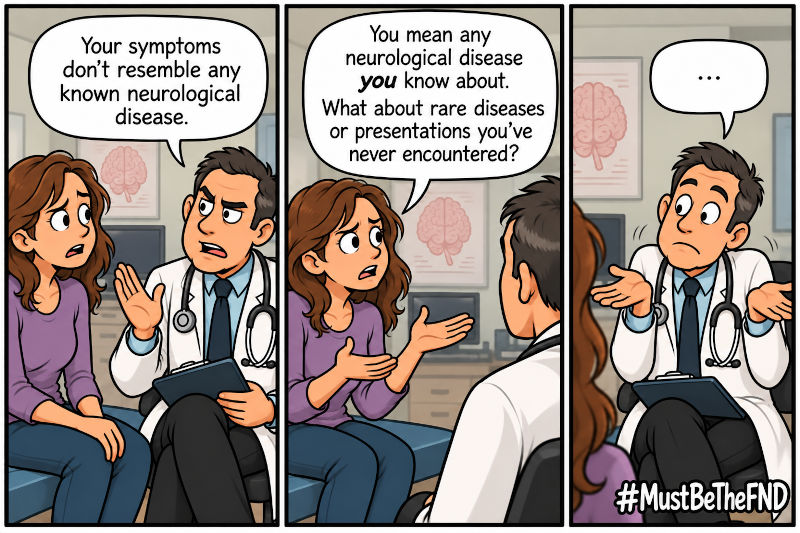
In January 2024, neurologist Jon Stone published an editorial in Practical Neurology titled Incongruence in FND: time for retirement. Stone, a prominent advocate of positive FND diagnosis, argued that incongruence should be abandoned as a diagnostic feature. His objections were fundamental: the concept effectively relies on exclusion, requires impossible neurological knowledge, cannot accommodate future discoveries and presumes an incomplete understanding of anatomy is sufficient to declare a presentation incompatible with neurological disease.
Stone was not rejecting FND or positive diagnostic signs. He was challenging one of the concepts historically used to justify the diagnosis. That distinction matters, but so does the question his editorial leaves unanswered: if incongruence is too unreliable to support diagnosis, how securely have the remaining positive signs been validated against competing neurological explanations?
Four reasons to abandon incongruence
Stone's first objection is that incongruence amounts to diagnosis by exclusion. A clinician encounters an unusual neurological presentation, decides that it does not resemble a recognised disease and treats that mismatch as evidence of FND. Stone argues that this is an insecure way to establish a diagnosis. The absence of a familiar explanation is not positive evidence for a particular alternative.
His second objection concerns the knowledge required to make such a judgement. A clinician would need sufficient familiarity with the entire range of neurological diseases and their possible presentations to establish that a finding was genuinely incompatible with them. Stone acknowledges that even experienced neurologists cannot possess that degree of knowledge.
Incongruence requires omniscience in clinical neurology.
His third objection follows directly from the second. Neurological knowledge changes. Conditions that once appeared inexplicable or bizarre may later become recognisable manifestations of newly identified diseases. Stone cites faciobrachial dystonic seizures associated with LGI1 encephalitis and unusual gait abnormalities associated with DYT4 as examples of presentations that challenge conventional expectations.
His fourth objection concerns anatomy. Declaring a presentation neurologically impossible assumes that current models adequately describe every relevant mechanism. Stone argues that developments in understanding brain function, including predictive processing, undermine such certainty.
Taken together, these objections dismantle a specific diagnostic inference: an unfamiliar presentation cannot be treated as evidence of FND merely because it fails to resemble the diseases a clinician currently recognises. The same observation might instead reflect incomplete investigation, an atypical disease presentation or limitations in existing medical knowledge.
This is a substantial concession about the limits of diagnostic reasoning. It is not evidence that every historical FND diagnosis based partly on incongruence was incorrect. It is an acknowledgement that incongruence, as Stone defines it, is an unsatisfactory basis for establishing one.
What Stone wants clinicians to use instead
Stone proposes retaining internal inconsistency and characteristic clinical features. Internal inconsistency describes differences in performance under different conditions, such as weakness during direct testing accompanied by stronger movement during an automatic task. Hoover's sign and tremor entrainment are familiar examples.
He develops his argument around a case of functional freezing of gait described by Nonnekes and colleagues. Stone considers the patient's internal inconsistency and characteristic features more informative than the claim that the gait does not resemble conventional Parkinsonism. He also acknowledges that some clinical findings can overlap with other neurological disorders and must be interpreted in context.
This approach avoids one obvious error: treating unfamiliarity itself as diagnostic evidence. But it introduces a separate evidentiary requirement. If a finding is considered characteristic of FND, how reliably does it distinguish FND from other conditions that might produce similar observations?
Stone's editorial does not answer that question through new diagnostic accuracy data. It provides a conceptual argument supported by clinical examples. It does not prospectively compare his proposed approach with competing diagnostic methods, establish new sensitivity or specificity estimates, or demonstrate that abandoning incongruence reduces misdiagnosis.
Those omissions are not flaws in the conduct of a study, because the paper is not a validation study. They are limitations on what can legitimately be concluded from the editorial. Stone makes a persuasive argument against one diagnostic concept without independently establishing the accuracy of the framework he prefers.
Inconsistency is not automatically specific
Internal inconsistency is an observable clinical finding. Its diagnostic significance, however, depends on whether the observed pattern has been adequately distinguished from alternative physiological or neurological mechanisms. A difference between voluntary and automatic movement establishes that performance varies between conditions. It does not, by itself, identify every mechanism capable of producing that variation.
A particularly relevant example appears in a 2018 case report by Merchant, Haubenberger and Hallett. A 62-year-old woman was evaluated for a tremor suspected to be functional. Her examination showed variability and apparent entrainment, features commonly used to support functional tremor diagnosis. Subsequent neurophysiological testing identified a persistent organic tremor component. Additional movements associated with contralateral tapping could be explained by mirror movements or motor overflow rather than true entrainment of the underlying tremor.
The case does not demonstrate that tremor entrainment is generally unreliable, nor does it exclude the possibility of a coexisting functional component. It demonstrates something narrower and clinically significant: a finding that appears to satisfy a positive diagnostic criterion can have an alternative explanation, and additional physiological testing can change its interpretation.
Further evidence comes from Jackson and colleagues' 2021 Mayo Clinic study, which retrospectively examined 116 patients referred for tremor electrophysiology. Additional testing contributed diagnostic information in 87 cases, including patients whose initial clinical impressions were changed or refined. The researchers also described distractibility and variability in some tremors classified as organic.
That study involved a selected population with diagnostically uncertain or complex tremors. It cannot be used to estimate the misdiagnosis rate of FND in general neurological practice. Nevertheless, it demonstrates why the interpretation of apparent positive signs may require additional investigation, particularly when the clinical presentation is ambiguous.
A 2018 clinical review by Cock and Edwards acknowledges comparable limitations in other examination findings. Give-way weakness can occur in acute pain, while certain movements associated with functional seizures may also appear in frontal lobe epilepsy. These examples reinforce a distinction that should not be lost: a sign may contribute useful diagnostic evidence without being exclusive to one disorder.
The research therefore supports a more cautious conclusion than either blanket acceptance or blanket rejection of positive signs. Some findings have documented diagnostic utility, but their interpretation depends on the particular sign, the competing diagnoses, examination technique and available validation evidence. The presence of a positive sign does not automatically establish that every alternative explanation has been adequately considered.
Predictive processing does not settle causation
Stone also argues that predictive processing offers a way to understand presentations previously considered anatomically incongruent. In this framework, the brain generates predictions about bodily states and continually integrates sensory information. Altered interactions between prediction and incoming information may help explain unusual experiences of movement, sensation or perception.
This is a proposed explanatory framework, not a demonstration that predictive-processing abnormalities caused the individual presentations discussed in the editorial. Stone's reasoning may make certain observations conceptually understandable without establishing a patient-specific disease mechanism.
The distinction is crucial. Showing that a model could explain a presentation is not the same as showing that it does explain that presentation. Nor does the model's compatibility with FND establish that the proposed mechanism is exclusive to FND.
Stone's criticism of anatomical incongruence therefore cuts both ways. If incomplete neurological knowledge makes it unsafe to declare a presentation impossible, that same incompleteness should constrain certainty about the mechanisms proposed to explain it.
What happens to differential diagnosis?
Stone is not arguing that clinicians should stop investigating other neurological diseases. He is arguing that the failure to recognise another disease should not itself count as positive evidence of FND. Those positions are different.
A positive diagnostic approach and an appropriate differential diagnosis are not mutually exclusive. A clinician can identify findings supporting FND while also investigating conditions suggested by the history, examination, progression or additional test results. The unresolved issue is how confidently the positive findings can be interpreted when plausible competing explanations remain.
That issue has practical consequences. If an inconsistent examination is interpreted as sufficient evidence of FND, a clinician may give less weight to findings that warrant further investigation. If the patient's condition subsequently progresses, the original interpretation should be open to reassessment rather than treated as settled.
Stone's editorial does not provide an operational standard specifying which competing diseases must be considered, when additional testing is warranted or what degree of diagnostic uncertainty should be communicated. Such decisions necessarily depend on the individual presentation, but their absence from the editorial limits its usefulness as a safeguard against diagnostic error.
The distinction also has implications for formal diagnostic criteria. The DSM-5 framework for conversion disorder refers to clinical findings demonstrating incompatibility between the presenting symptoms and recognised neurological or medical conditions. Stone's proposed retirement of incongruence therefore challenges language closely associated with the established diagnostic framework. His editorial does not establish that all uses of the DSM incompatibility criterion are equivalent to the particular reasoning he criticises, but the conceptual tension deserves explicit attention.
A correction, not a validation
Stone's editorial exposes a genuine weakness in traditional FND diagnostic reasoning. Incongruence depends on a clinician's assessment of what other neurological diseases can and cannot look like. That assessment is constrained by experience, available evidence and the limits of current neurological knowledge.
Removing incongruence from diagnostic reasoning would eliminate one route by which unfamiliar presentations might be mistaken for positive evidence of FND. But the change does not automatically validate internal inconsistency, characteristic features or predictive-processing explanations.
Those claims require their own evidence. Diagnostic studies must establish how reliably particular signs distinguish FND from relevant alternatives, whether different examiners interpret them consistently, and how well their apparent accuracy holds in patients with atypical, evolving or diagnostically uncertain neurological conditions.
Stone has identified a problem with the logic of diagnosis. The next question is whether the remaining diagnostic evidence is strong enough to support the certainty sometimes attached to it. Retiring an unsatisfactory criterion is a correction. It is not proof that the replacement is sufficiently reliable.
References
- Stone J. (2024). Incongruence in FND: time for retirement. Practical Neurology, 24(2), 163–165. Primary editorial analysed.
- Nonnekes J, Tibben M, van de Venis L, Bloem BR. (2024). Functional freezing of gait: lessons from compensation. Practical Neurology. Clinical case prompting Stone's editorial; first published online in 2023.
- Merchant SH, Haubenberger D, Hallett M. (2018). Mirror movements or functional tremor masking organic tremor. Clinical Neurophysiology Practice, 3, 107–113. Case report examining apparent entrainment and organic tremor.
- Jackson L, Klassen BT, Hassan A, et al. (2021). Utility of tremor electrophysiology studies. Clinical Parkinsonism & Related Disorders, 5, 100108. Retrospective study of 116 patients.
- Cock HR, Edwards MJ. (2018). Functional neurological disorders: acute presentations and management. Clinical Medicine, 18(5), 414–417. Clinical review discussing positive diagnostic signs and their limitations.
- Hallett M, et al. (2024). Clinical neurophysiology of functional motor disorders: IFCN Handbook Chapter. Clinical Neurophysiology Practice. Technical discussion of electrophysiological examination and interpretation of functional motor signs.