FND Nope
Trophies


Posts
5
When an Unexplained Gait Became Conversion Disorder: A Huntington’s Disease Case
A 65-year-old woman with an abnormal gait, cognitive decline and psychiatric symptoms was diagnosed with conversion disorder after inconclusive neurological investigations. Years later, genetic testing confirmed Huntington’s disease—raising a difficult question: what positive evidence had established conversion disorder in the first place?
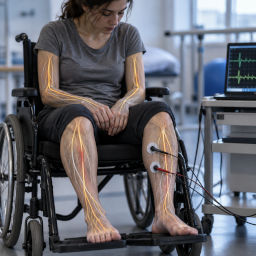
When FND Overshadowed an Axonal Neuropathy: A Case of AMSAN
A 22-year-old woman entered rehabilitation with FND as her primary diagnosis while an underlying acute motor and sensory axonal neuropathy (AMSAN) remained unrecognised. EMG and nerve conduction studies later demonstrated extensive axonal damage, leading to IVIG treatment and improved rehabilitation progress. The authors explicitly describe the case as diagnostic overshadowing.

When Suppressible Movements Were Called Functional: A Genetic PKD Case
A 14-year-old boy was diagnosed with a functional movement disorder after presenting with suppressible involuntary movements and psychiatric comorbidity. Further investigation identified monogenic paroxysmal kinesigenic dyskinesia (PKD), while the authors noted that specific positive features supporting the original functional diagnosis had been absent.

FND, Then Genetic Dystonia: A Pediatric DYT-TOR1A Case
A pediatric patient diagnosed with Functional Neurological Disorder was later found to have DYT-TOR1A dystonia and responded well to deep brain stimulation. The authors retained FND as a coexisting diagnosis, raising an important question: once a genetic disorder capable of producing the movements was identified, what evidence determined which symptoms remained functional?

Differential Diagnosis: Vitamin B12
B12 enables myelin production and nerve signalling; without it, nerves become damaged, causing neurological symptoms. As Dr J Stone acknowledges, testing for vitamin B12 levels should really be a routine part of a neurological investigation, something even a trainee should be aware of.
Comments
27Thank you for this, will definitely check Dr Binita Kane out.
Another angle around Long Covid is that there seems to be a gut microbiome connection?
(As it is with Multiple Sclerosis and Parkinson's)
Research shows that many people with Long COVID have persistent dysbiosis lower, diversity in gut bacteria and a loss of beneficial SCFA-producing species like Faecalibacterium, Bifidobacterium, and Roseburia. This imbalance can weaken the gut barrier, fuel ongoing inflammation, and contribute to fatigue, brain fog, GI issues, and other symptoms via the gut-brain and gut-lung axes.
But not something I've investigated in too much details yet.
Hi @Con Bradley , I merged your anonymous accounts, so all good 🙂
Generally, Functional Neurological Disorder (FND), when clinicians follow the rules and guidelines, is supposed to be diagnosed on the basis of positive signs rather than by exclusion. It is not meant to be a "nothing else fits" diagnosis. Unfortunately, in practice many clinicians still use it as a wastebasket category.
That said, even when the diagnosis is made according to correct guidelines, the so-called positive signs are not specific to FND, they are also found in many other conditions. We would go so far as to suggest that what is currently labeled "functional" may in the future prove to be a common phenotype, much like pain is a shared feature across many different disorders. In other words, the "functional" presentation is likely a reflex reaction to an underlying cause that is triggering the symptoms. Clinicians will therefore need to focus on identifying that underlying cause.
Did you ask for a second opinion yet?
I will be sure to check out the book you mentioned.
Thank you for sharing your story. I'm really sorry you've been through this. We understand how frightening and life changing cognitive symptoms can be because we've experienced similar challenges ourselves. The way you describe losing abilities that once came naturally is something many people can relate to, and it sounds incredibly difficult.
Can I ask how your doctors arrived at the FND diagnosis? Your symptoms seem to be almost entirely cognitive rather than motor. Did they specifically diagnose Functional Cognitive Disorder (FCD), which is generally considered a cognitive subtype within the FND umbrella, or was it diagnosed simply as FND? We'd be interested to know what positive clinical features or assessments led them to that conclusion.
Also have a look at https://fndnope.org/posts?postId=55
Useful tweets
Dr. Rebecca Ryan, BMBS (Hons), FRACP
Gastroenterologist & Hepatologist
Specialising in Disorders of the Gut Brain Axis
info@drrebeccaryan.com.au
Dr. Ryan's approach focuses on a comprehensive assessment of the entire gut brain axis, recognising that symptoms often arise through the interaction of multiple factors, including genetics, diet, exercise, stress, and other physiological processes.
We can certainly discuss emerging evidence from α-synuclein seed amplification assays (SAAs) and other biomarkers, but this post is not about Parkinson's. It is an interesting side discussion though. I agree that Parkinson's remains a clinical diagnosis (Parkinson's diagnosis is also subject to clinician bias and diagnostic error). However, over time the diagnosis is typically either strengthened or weakened as the disease evolves.
Likewise, only time will tell whether the functional symptoms return in this case. At present, however, the patient has remained symptom free for the reported three month follow up after repair of the CSF leak.
Technically, what you're laying out is a syllogism or deductive argument:
- The motor symptoms were characteristic of FND.
- A CSF leak cannot produce those motor symptoms.
- Therefore, the motor symptoms must have been FND.
The point I am exploring is whether premise 2 is necessarily true, or whether the CSF leak, or the underlying biological process associated with it, could instead have produced a functional appearing motor phenotype.
What do we make of an FND diagnosis that completely resolves following treatment of another neurological disorder? If a patient once met the diagnostic criteria for FND, does that diagnosis remain indefinitely, regardless of what happens afterwards? Or should complete resolution following treatment of another neurological disorder at least prompt reconsideration of the original diagnosis? If the patient remains symptom free for 1 year, 5 years, or 10 years after repair of the CSF leak, at what point would the longitudinal data become sufficient to reconsider the original diagnosis?
One thing I also find interesting is that most of your criteria are retrospective. They describe how to reassess an existing FND diagnosis after new information becomes available. From a strict Karl Popper perspective, however, falsifiability is about specifying what observations would count against a hypothesis, not simply how we reinterpret observations after the fact. That is why I find the falsifiability question so interesting.
Of course, if FND is ultimately better understood as a common neurological phenotype rather than a distinct disorder, then much of this discussion becomes largely irrelevant. The question would no longer be whether the patient "still had FND," but rather what underlying biological process produced the functional appearing phenotype in the first place.
Thanks for the thoughtful comment.
My point is not that this case proves the patient never had FND or that CSF leaks generally explain FND. It is about what evidence would actually count against an established FND diagnosis.
That is also why I don't think the comparison with Parkinson's disease is quite equivalent. Parkinson's has converging biological evidence and established biomarkers, making questions of falsification considerably less ambiguous. My question is specifically about what would falsify a clinical FND diagnosis.
The explanations you propose, such as placebo effects, predictive processing, attention, functional overlay, or future relapse, are all possible. However, from a strict Karl Popper perspective, they function as auxiliary hypotheses that preserve the original diagnosis rather than exposing it to the risk of falsification. If every seemingly contradictory observation can be accommodated by adding another explanation, then the diagnosis becomes increasingly difficult to falsify.
That is what I find interesting. If complete resolution following successful treatment of another neurological disorder is still insufficient to prompt reconsideration of the diagnosis, what observation would?
I am also intrigued by the authors' choice of the phrase "functional appearing symptoms" rather than simply "functional symptoms." That wording seems to leave open the possibility that the presentation resembled FND without necessarily reflecting its proposed mechanism, which is why I raise the common phenotype hypothesis as an alternative interpretation rather than a conclusion.
Discussions started
7Share your FND memes and cartoons here.
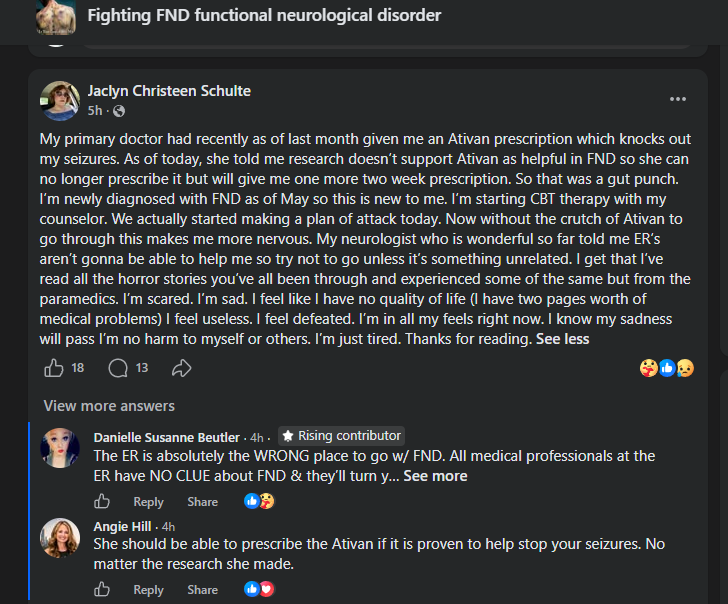
Researchers say medicine doesnt work for FND but thats pure conjecture when no one fully knows what causes these symptoms or how the brain is glitching. We cant keep denying people treatments that might help just because of an unproven hypothesis. If it works for someone its usually just treating their claimed comorbidities like pain mood or sleep not the core FND itself. Stop gatekeeping based on theories. Personal results matter more than the current official line.
Whenever I read an FND advocacy page, I like to go back in time using the Internet Archive to see how the narrative has evolved. Comparing older versions with current ones often reveals not just changes in wording, but shifts in priorities and values.
- Original page: http://web.archive.org/web/20160904034822/https://www.fndaction.org.uk/diagnosis/
- Current page: https://www.fndaction.org.uk/diagnosis/
The 2016 page had soul. It was written by patients, for patients. It openly acknowledged the harm people experienced: being made to feel their symptoms were "their fault," being dismissed, left without support, and let down by inconsistent care. It felt urgent, validating, and unapologetically activist.
The current page feels sanitized and clinician focused. It reads as though it was edited by neurologists concerned about sounding too speculative or unscientific. The raw expression of patient suffering is gone. The frustration with poor care is gone. In its place are lengthy discussions of diagnostic pitfalls, positive signs, research priorities, and carefully worded disclaimers. It is all very proper, but it also feels cold and defensive.
Rather than centering the needs of people living with FND, the page seems more concerned with protecting the reputation of the diagnosis. The charity appears to have exchanged genuine patient advocacy for mainstream medical respectability, and in doing so, lost much of its original purpose and emotional impact.
The end result is a page that may be more technically accurate, but is significantly less human. It serves clinicians and the diagnosis better than it serves the patients who are suffering.
Hey everyone
This site is very new and evolving quickly.
What features, enhancements, or changes would you like to see?
Reply under this post with your ideas!
All suggestions welcome - let's build this together!
Hey everyone
This site is very new and evolving quickly.
If you spot any bugs (broken links, formatting issues, mobile glitches, comment problems, etc.),
please reply under this post.
Include:
- Device + browser
- What happened
- Screenshot if possible
Thanks for helping improve it!
This is the place to share the craziest "my FND did this" claims you’ve seen, hair loss, sudden allergies, psychic powers, eyes changing color, poltergeist activity, speaking unknown languages, etc.
Drop the most ridiculous ones below!
When we initially investigated FND, we were surprised to find almost no official skepticism.
Dr. David Tuller, through his “Trial By Error” series on virology.ws (https://virology.ws/tag/fnd/)He has challenged inflated prevalence claims, the reliability of diagnostic signs, and aspects of FND’s psychological framing.
Are there any other skeptical sources out there?
Did the clinicians provide you with a treatment plan? Or with any steps forward?
Or was this a hit and run diagnosis?