Resume drafts Unsaved story and dashboard drafts
Comment drafts Unsaved comment drafts
FND Nope profile picture

FND Nope

Public profile
Moderator
2 posts 27 comments 7 discussions Last seen 15 Sep 2026 Member since 05 Jul 2025
Challenging the FND philosophy seeking truth beyond misdiagnosis. Advocating for real answers, thorough investigation, and respect in neurological care.
Stance towards FND
Unknown
Trophies
Posts
2
Filtered by tag
In the news
A collection of news coverage and public reporting on Functional Neurological Disorder (FND), highlighting real-world cases, medical perspectives, and ongoing discussions around diagnosis, treatment, and lived experience.
Maddie Aumann: From an FND Diagnosis to Maddie’s Law
1 week ago

Maddie Aumann was diagnosed with FND before genetic testing identified a rare SCN9A disorder. Her mother, Christine Aumann, describes how the FND label continued to affect Maddie’s care even after that discovery, ultimately helping inspire Maddie’s Law.
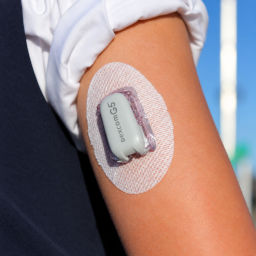
Diagnosed With FND After Three Weeks: 200 Seizures Later, Doctors Found Severe Hypoglycaemia
5 days ago

Diagnosed with FND after three weeks, an Australian teenager endured around 200 seizures before severe hypoglycaemia linked to a gastrointestinal motility disorder was identified.
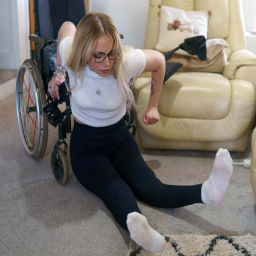
The Medical Journey of Megan Dixon: FND and Severe Disability
3 months ago

Megan Dixon became severely disabled following childhood illness, with progressive loss of mobility and speech leading to prolonged hospitalisation. She was later reportedly diagnosed with FND and underwent extended rehabilitation after years of severe impairment.

Comments
27
Replied to Hoping one day we each will recover · 31 May 2026
Thank you for sharing your daughter's story. It is heartbreaking and infuriating at the same time. The gaslighting you both endured for over two years, the isolation, and the way FND became an easy label to shut down real investigation hits so close to home for so many of us here. Dr. Chopra's words "I look at the patient, not just the scans" are powerful. That kind of thorough care is exactly what is missing in too many cases. I am glad you found him and that your daughter has had the tethered cord surgery. The road ahead with recovery and PT sounds long, but there is real hope now that the structural issue has been addressed. Your post is going to help other parents who are stuck in the same conveyor belt. Wishing your daughter steady progress and strength for both of you in the months ahead. One day at a time toward that recovery you both deserve.

Replied to ANTIBIOTICS CURED ME OF FND ! · 31 May 2026
Thank you for sharing this detailed and courageous account Lymewearier. Your story powerfully illustrates the real frustrations many face: dismissive neurology, over reliance on imperfect Lyme serology, and the dangers of FND becoming a catch all that halts further investigation. The symptom overlap between late neuroborreliosis PTLDS and co infections like Babesia Bartonella and FND is striking. Fluctuating paresthesia, tremors, seizure like episodes, fatigue, cognitive issues, and even optic nerve involvement have all been documented in tick borne disease literature. Your history of a classic EM rash in 2011, partial response to initial antibiotics, and further improvement with targeted private treatment plus private testing showing immunocomplexes makes a strong case that infection was the primary driver here, not a functional disorder. Cases like yours highlight why we need better tick borne disease awareness, improved direct detection tests, and multidisciplinary approaches that do not default to psychiatric too quickly. It is tragic when treatable infections get relabeled as FND. Wishing you continued recovery and stable vision. Stories like this are vital for pushing better care and reducing misdiagnosis in both directions. Has anyone else here had similar experiences with co infections or optic neuropathy resolving improving post treatment?

The discussion was largely unproductive, unfortunately. I don’t see much point in continuing it further. The clinician here simply echoed the same approach as his colleague in the clinical setting: dismissing the isokinetic data showing clear, reproducible fatigable weakness while assuming a functional diagnosis upfront. Hoover’s sign was negative, consistent with the preserved initial low-demand strength, yet the actual fatigue pattern was never addressed. The patient remains without proper investigation or answers for the measurable deficit. This exchange shows exactly why a site like this is necessary.

"You are assuming functional weakness should always lead to weakness at movement initiation. That's not true though. People can and often do experience functional weakness with repeated or sustained movement" This post is not arguing against functional weakness, or even functional fatigable weakness. The core question is whether Hoover's sign is an appropriate tool for assessing fatigue-dependent weakness. If so, how would it be applied in practice? Are there any references or protocols supporting its use? Would actual repetitions be performed using Hoover's sign, and how would it be physically applied? I am genuinely interested.

Just a reminder for the clinician in the comment section: FND requires positive rule-in signs. Some context about Christoff's wife: even though Hoover’s sign is mentioned here, functional rule-in signs were never found, and the FND diagnosis was made purely because a diagnostic impasse was reached. (the dynamic spinal cord compression part is purely hypothetical, not sure if you make use of dynamic MRI's in your practice at all?) In the South African context, the term “biokinetical” as per biokineticist reports, refers to genuine mechanical movements that consistently and repeatedly produce facial asymmetry. These movements have been evident (in her case) for the past 30 years, long before the onset of any neurological symptoms.

I think everyone understands that we are dealing with analogies here, and the post itself even pre-empts the “it is just an analogy” criticism. However, the discussion here involves hypotheticals, and it does not take much imagination to see that the analogy can also be extended from a sceptical perspective. It is well known and openly discussed by neurologists such as Jon Stone that organic conditions can sometimes mimic functional presentations. Because of that, considerable care is required when applying a diagnosis like this. My greater concern, however, is the suggestion from Anonymous that only neurologists should be allowed to discuss issues like this. If dialogue is discouraged in that way, the topic risks becoming a sacred cow rather than something that can be openly examined. This also avoids the elephant in the room. Yes, Functional Neurological Disorder is accepted within mainstream medicine and used as a clinical diagnosis. But the field itself does not hide the fact that the underlying explanatory framework is still evolving and remains partly hypothetical. In that sense, we are inevitably dealing with models and abstractions rather than a fully settled mechanism.

The part that scares me, is that by the logic of strict FND proponents (in this thread), early or atypical ALS could be dismissed as FND in some cases—especially if initial presentations are fluctuating, involve weakness/speech/swallowing issues without clear upper/lower motor neuron signs on exam, or if routine MRIs/early EMGs are normal or nonspecific.

Discussions started
7
Started Share you FND memes and cartoons on 22 Aug 2026
6 replies

Share your FND memes and cartoons here.


Started Denying medicine on 21 Jul 2026

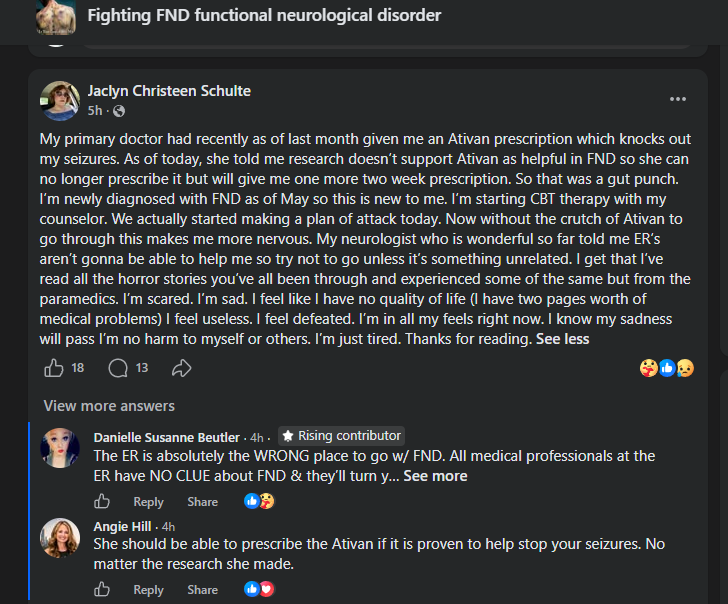
Researchers say medicine doesnt work for FND but thats pure conjecture when no one fully knows what causes these symptoms or how the brain is glitching. We cant keep denying people treatments that might help just because of an unproven hypothesis. If it works for someone its usually just treating their claimed comorbidities like pain mood or sleep not the core FND itself. Stop gatekeeping based on theories. Personal results matter more than the current official line.


Started Has FND Advocacy Lost Its Soul? on 11 Jul 2026
1 reply

Whenever I read an FND advocacy page, I like to go back in time using the Internet Archive to see how the narrative has evolved. Comparing older versions with current ones often reveals not just changes in wording, but shifts in priorities and values.


  1. Original page: http://web.archive.org/web/20160904034822/https://www.fndaction.org.uk/diagnosis/
  2. Current page: https://www.fndaction.org.uk/diagnosis/


The 2016 page had soul. It was written by patients, for patients. It openly acknowledged the harm people experienced: being made to feel their symptoms were "their fault," being dismissed, left without support, and let down by inconsistent care. It felt urgent, validating, and unapologetically activist.


The current page feels sanitized and clinician focused. It reads as though it was edited by neurologists concerned about sounding too speculative or unscientific. The raw expression of patient suffering is gone. The frustration with poor care is gone. In its place are lengthy discussions of diagnostic pitfalls, positive signs, research priorities, and carefully worded disclaimers. It is all very proper, but it also feels cold and defensive.


Rather than centering the needs of people living with FND, the page seems more concerned with protecting the reputation of the diagnosis. The charity appears to have exchanged genuine patient advocacy for mainstream medical respectability, and in doing so, lost much of its original purpose and emotional impact.


The end result is a page that may be more technically accurate, but is significantly less human. It serves clinicians and the diagnosis better than it serves the patients who are suffering.


2 replies

Hey everyone

This site is very new and evolving quickly.

What features, enhancements, or changes would you like to see?

Reply under this post with your ideas!

All suggestions welcome - let's build this together!


Started Reporting Bugs on 02 Jul 2026

Hey everyone

This site is very new and evolving quickly.

If you spot any bugs (broken links, formatting issues, mobile glitches, comment problems, etc.),

please reply under this post.

Include:

  1. Device + browser
  2. What happened
  3. Screenshot if possible


Thanks for helping improve it!


6 replies

This is the place to share the craziest "my FND did this" claims you’ve seen, hair loss, sudden allergies, psychic powers, eyes changing color, poltergeist activity, speaking unknown languages, etc.

Drop the most ridiculous ones below!


Started Other skeptical sources on 19 Jun 2026
6 replies

When we initially investigated FND, we were surprised to find almost no official skepticism.


Dr. David Tuller, through his “Trial By Error” series on virology.ws (https://virology.ws/tag/fnd/)He has challenged inflated prevalence claims, the reliability of diagnostic signs, and aspects of FND’s psychological framing.


Are there any other skeptical sources out there?