
FND Study of Nearly 600,000 Patients Reveals Different Biological Patterns Behind Different Symptoms
 FND Nope
Moderator
A study published on 22 October 2026 in Psychological Medicine examined nearly 600,000 patients diagnosed with functional neurological disorder (FND) or functional somatic symptoms. The researchers found that inherited conditions, congenital abnormalities, neurodevelopmental disorders and certain birth complications were more common in these patients than in matched groups diagnosed with migraine or recurrent depression. More importantly, different clinical presentations were associated with different biological conditions. Patients labelled with functional motor disorders did not have the same association patterns as those labelled with functional seizures.
The researchers interpret these findings as evidence that early-life biological abnormalities may create a vulnerability to developing functional symptoms. There is another explanation worth examining: perhaps different biological conditions produce overlapping clinical presentations, and some of those presentations are subsequently classified as FND. That possibility is central to what we call the Common Phenotypes Hypothesis. The study does not prove this hypothesis, but its findings are consistent with it, and its methodology cannot distinguish between the two explanations.
What the researchers actually investigated
Ester Ipavic and colleagues analysed records from TriNetX, a large electronic health record network containing data from more than 164 million patients at the time of analysis. Their study included 188,868 individuals diagnosed with FND and 406,202 diagnosed with functional somatic symptoms. Each group was compared against demographically matched cohorts with migraine and recurrent major depressive disorder. The researchers examined diagnoses recorded before the first documented FND or functional somatic diagnosis, looking for inherited, congenital, perinatal and neurodevelopmental conditions.
The matching accounted for age, sex or gender as recorded in the database, race, ethnicity and documented socioeconomic or psychosocial stressors. Additional analyses examined medical comorbidities, repeated diagnostic coding and conditions documented more than a year before the index diagnosis. These measures strengthen the observational findings, but they do not establish that the original FND diagnoses were correct or that the associated biological conditions caused a separate functional disorder.
The biological associations
The researchers reported increased odds of several conditions among patients carrying FND or functional somatic symptom diagnoses. Across the study's comparisons, the reported associations included:
- Ehlers–Danlos syndrome: odds ratios ranging from 2.1 to 3.6.
- Chromosomal abnormalities: odds ratios ranging from 2.5 to 3.2.
- Congenital musculoskeletal malformations: odds ratios ranging from 1.7 to 2.0.
- Low birth weight and related developmental factors: odds ratios ranging from 1.8 to 2.4.
- Intellectual disability: odds ratios ranging from 1.9 to 5.4.
- Autism spectrum disorder: odds ratios ranging from 1.2 to 3.5.
These ranges combine different diagnostic groups and comparator populations; they are not a single risk estimate for FND. An odds ratio of three does not mean that three times as many patients necessarily have a condition, nor does it establish causation. The authors also report that most of the inherited and congenital conditions examined occurred in fewer than 1% of patients, despite their elevated relative associations. That distinction matters. Large relative differences can coexist with small absolute numbers.
Nevertheless, the findings raise a straightforward question. When a patient already has a connective tissue disorder, neuromuscular condition or congenital nervous-system abnormality, how thoroughly has that condition been investigated as a possible explanation for symptoms subsequently labelled functional? This study cannot answer that question because it did not independently assess individual patients or verify the mechanisms responsible for their symptoms.
Different symptoms, different biological associations
This is arguably the most important part of the paper. The researchers identified 47,915 patients with functional motor disorder and 63,269 with functional seizures. After matching, 42,015 patients remained in each group. The two presentations showed different patterns of associated conditions.
- Functional motor disorder: stronger associations with primary muscle disorders, connective tissue disorders, communication disorders and congenital musculoskeletal malformations.
- Functional seizures: stronger associations with intellectual disability, autism spectrum disorder, chromosomal abnormalities, congenital nervous-system malformations, specific learning disorders and ADHD.
The differences extended beyond neurological presentations. Among patients classified with functional somatic symptoms, musculoskeletal presentations were more strongly associated with connective tissue conditions and congenital musculoskeletal abnormalities. Gastrointestinal presentations showed associations with primary muscle disorders, chromosomal abnormalities, short gestation or low birth weight, and selected neurodevelopmental conditions. The cardiopulmonary and genitourinary groups showed fewer distinct associations.
These are associations between diagnostic categories, not proof that any particular condition explains a patient's symptoms. But the pattern is worth investigating. The biological conditions associated with a presentation appear to differ according to the type of symptoms being classified. That is precisely the kind of heterogeneity one might expect if several underlying biological processes can produce similar clinical phenotypes.
The Common Phenotypes Hypothesis
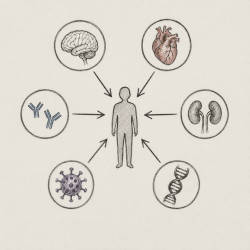
The Common Phenotypes Hypothesis proposes that clinical presentations grouped under a diagnostic label such as FND may sometimes represent overlapping phenotypes produced by different underlying biological mechanisms, rather than necessarily representing manifestations of one distinct disorder. Weakness, abnormal movements, sensory disturbances, seizure-like episodes and autonomic symptoms are clinical observations. Their appearance does not, by itself, establish a single cause. Different diseases can interfere with the same physiological systems and produce similar symptoms, particularly when the underlying mechanisms are poorly understood, incompletely investigated or not detectable using routine tests.
The Common Phenotypes Hypothesis: Similar neurological presentations may arise from multiple distinct biological processes. A shared clinical phenotype does not necessarily establish a shared disease mechanism, and assigning a functional diagnosis does not independently demonstrate that an underlying biological cause has been excluded or adequately characterised.
Consider two patients with abnormal movements. One has a hereditary muscle disorder; another has a connective tissue condition affecting proprioception and joint stability. Their symptoms may look similar during a neurological examination, but the mechanisms responsible could be entirely different. Alternatively, either patient could genuinely have an additional functional movement disorder. The clinical presentation alone cannot resolve those possibilities. Establishing which explanation applies requires more than identifying a pattern and assigning a diagnostic code.
The researchers found that muscle and connective tissue conditions were disproportionately represented in functional motor presentations, while neurodevelopmental and chromosomal conditions were more prominent in functional seizure presentations. Under the authors' interpretation, these conditions may predispose patients to developing FND. Under the Common Phenotypes Hypothesis, at least some of these conditions may contribute directly to the symptoms being classified as functional. Both explanations are compatible with the reported associations. The study was not designed to determine which is correct.
Where the study makes an important assumption
The paper repeatedly frames the identified biological conditions as vulnerability factors. Its discussion suggests that inherited abnormalities, altered sensory signalling, developmental differences and unreliable bodily feedback may increase susceptibility to functional symptoms. The authors connect this interpretation to predictive processing models, in which altered sensory precision and expectations are proposed to contribute to symptom generation.
But finding a biological condition in someone diagnosed with FND does not establish that the condition is merely a predisposition to FND. It might be a predisposition, a coincidental comorbidity, a contributing mechanism, an independent cause of some symptoms, or evidence that the original diagnosis deserves reconsideration. The study does not separate these possibilities.
That distinction is not semantic. It changes the scientific question being asked. Instead of asking only why people with inherited or developmental abnormalities are more vulnerable to FND, researchers should also ask whether some of those abnormalities explain the neurological presentations attributed to FND in the first place. A biological association should not automatically be converted into evidence supporting a functional mechanism when that mechanism has not been independently demonstrated.
The limitations are not minor
The authors acknowledge several limitations inherent to retrospective electronic health record research. Diagnoses were identified through ICD-10 codes, and those codes cannot establish the clinical accuracy of an individual diagnosis. The study did not independently re-examine patients, review the diagnostic reasoning in every case or determine whether the associated biological conditions could account for the symptoms classified as functional. Its functional somatic symptom groups were also constructed using diagnostic and symptom codes rather than independently validated clinical subtypes.
In fact, the authors explicitly acknowledge that symptoms used to define some functional somatic groups could reflect structural, inflammatory or other coexisting medical conditions. They also acknowledge possible diagnostic misclassification. Yet their discussion refers to FND misdiagnosis as rare, citing earlier research. That claim does not validate the diagnoses in this dataset. Nor does it establish that an inherited neuromuscular condition, for example, was adequately assessed before a patient's symptoms were attributed to FND.
The researchers also found substantial under-recording of certain conditions. Combined Ehlers–Danlos syndrome and hypermobility syndrome appeared in only 1.4% of the FND cohort, while the authors cited substantially higher general-population estimates for joint hypermobility. Autism was likewise recorded at lower rates than some previous clinical estimates. Such differences illustrate how heavily electronic health record studies depend on which conditions clinicians recognise, investigate and document. Greater healthcare contact and more intensive investigation may also affect which diagnoses appear in different patient groups.
The sensitivity analyses produced broadly similar associations after restricting records to diagnoses made more than a year before the index diagnosis and after accounting for several additional factors. That makes it harder to dismiss the entire pattern as a simple coding artefact. It still does not establish causation, diagnostic accuracy or the proposed vulnerability mechanism.
What would actually test the competing explanations?
A more decisive study would recruit patients with clearly defined neurological phenotypes and investigate their underlying mechanisms independently of the diagnostic labels already assigned to them. Researchers could compare detailed neurological examinations with genetic findings, neuromuscular testing, autonomic investigations, connective tissue assessments, neurophysiology and longitudinal outcomes where clinically indicated. They would also need to examine whether established biological conditions plausibly explain the specific symptoms attributed to FND, rather than automatically treating those conditions as unrelated comorbidities or predisposing factors.
Such research could test whether particular clinical phenotypes divide into biologically distinct subgroups, whether certain mechanisms are shared across apparently different diagnoses, and whether more precise investigation changes the original diagnostic classification. It could also identify patients in whom a functional diagnosis remains independently supported. The point is to test competing explanations, not assume the answer in advance.
The present study cannot tell us how many FND-labelled patients might have symptoms directly attributable to an existing biological condition, how many have a separate functional disorder, or how many have both. It cannot establish that most FND diagnoses are incorrect. Those conclusions would require individual-level clinical and mechanistic evidence that the researchers did not collect.
The conclusion
This study provides substantial evidence that FND-labelled populations are biologically heterogeneous and that different clinical presentations are associated with different inherited, congenital, perinatal and neurodevelopmental conditions. The researchers interpret these findings as evidence of biological vulnerability to functional symptoms. The Common Phenotypes Hypothesis offers a competing, testable interpretation: some of the apparent heterogeneity may reflect different biological processes producing overlapping symptoms that are subsequently grouped under functional diagnostic labels.
Neither interpretation has been established by this dataset. What the study does establish is that the associated biological conditions cannot simply be ignored. When researchers identify inherited muscle disorders, connective tissue abnormalities, congenital nervous-system conditions and chromosomal abnormalities in patients carrying functional diagnoses, those findings deserve investigation as potential contributors to the clinical presentation, not merely incorporation into another theoretical explanation of FND.
Finding a biological abnormality and calling it a vulnerability is not the same as demonstrating what caused the patient's symptoms. Until that distinction is investigated directly, the central question remains unanswered.
References
- Ipavic E, Pollak TA, Nicholson TR, et al. (2026). Inherited and early-life vulnerability in functional neurological disorder and functional somatic symptoms: A retrospective cohort and case–control study from a large electronic health record database. Psychological Medicine, 56, e338.
- Chen G, Olver JS, Kanaan RA. (2021). Functional somatic syndromes and joint hypermobility: A systematic review and meta-analysis. Journal of Psychosomatic Research, 148, 110556.
- Margolesky J, Puentes D, Espay AJ. (2022). Hypermobile Ehlers-Danlos syndrome: A prodromal subtype of functional movement disorders? Movement Disorders Clinical Practice, 9(7), 956–960.
- Herbert LD, Kim R, Hassan AAO, Wilkinson-Smith A, Waugh JL. (2021). When neurologists diagnose functional neurological disorder, why don't they code for it? CNS Spectrums, 26(6), 664–674.
- Fernandez A, Jaquet M, Aubry-Rozier B, et al. (2024). Functional neurological signs in hypermobile Ehlers–Danlos syndrome and hypermobile spectrum disorders with suspected neuropathic pain. Brain and Behavior, 14(2), e3441.
- Smythe L, Asan L, Nicholson TR, Happé F, Edwards MJ. (2025). Co-occurring functional neurological disorder and autism: An exploratory study of comorbidities in a retrospective cohort study using TriNetX. Journal of Neurology.
- Edwards MJ, Adams RA, Brown H, Pareés I, Friston KJ. (2012). A Bayesian account of 'hysteria'. Brain, 135(11), 3495–3512.

What we call FND may not be a distinct disorder at all, but a collection of common neurological presentations that occur across numerous diseases. Grouping these presentations under a single diagnostic label does not establish a shared underlying pathology or mechanism.