
Functional Limb Weakness: When the Signs Used to Diagnose FND May Have Another Origin
 FND Nope
Moderator
A patient develops weakness in one leg and visits a neurologist. During examination, the leg appears weak when the patient tries to move it voluntarily, but produces greater force during a different movement involving the opposite leg. The neurologist identifies Hoover's sign and interprets the discrepancy as evidence of Functional Neurological Disorder (FND). Yet what has actually been established? The examination has demonstrated a difference in muscle activation under different conditions. Whether that difference identifies the cause of the patient's illness is another question entirely.
This distinction is central to the Functional Limb Weakness guide on NeuroSymptoms, a patient information website associated with Professor Jon Stone. The guide describes functional weakness as a problem with how the nervous system operates rather than damage or disease of the nervous system. A February 2013 factsheet published by Chest Heart & Stroke Scotland, adapted from material supplied by Stone, presents essentially the same explanation. Both documents describe clinical signs used to support the diagnosis, but the interpretation of those signs deserves closer scrutiny, particularly in light of research documenting similar findings in other neurological conditions.
The Diagnosis Assumes What the Examination Must Establish
The NeuroSymptoms guide states that functional limb weakness is not caused by nervous-system damage or disease. It explains that the components of the nervous system remain intact but do not work properly, using the familiar analogy of a computer with a software problem rather than a hardware problem. The 2013 factsheet makes the same distinction. This explanation is presented to patients as though the underlying nature of their weakness has already been established, yet the clinical findings described in these documents do not independently demonstrate the absence of neurological pathology.
A discrepancy between voluntary and automatic movement does not provide a comprehensive assessment of the nervous system. Neither does a normal scan establish that every relevant neurological disorder has been excluded. Imaging techniques have limitations, diseases can evolve, and some abnormalities may not be detectable using routine investigations. The question is not whether clinicians can observe unusual patterns of weakness, but whether those observations justify the causal explanation attached to them. Calling a problem functional does not demonstrate that its underlying cause has been identified.
Hoover's Sign: An Observation Becomes an Explanation
Hoover's sign is one of the principal examination findings described in both documents. The test compares voluntary hip-extension effort with the associated extension force generated when the opposite hip flexes against resistance. A patient may demonstrate limited force when deliberately pressing one leg downward but greater force during movement of the opposite leg. NeuroSymptoms interprets this return of automatic movement as showing that the weakness is not caused by damage. That conclusion goes beyond the observation itself: the examination demonstrates preserved force under a particular condition, but the origin and clinical significance of the discrepancy require further evidence.
A 2011 prospective, unblinded study by McWhirter and colleagues examined Hoover's sign among 124 patients with leg weakness presenting in a suspected-stroke setting. Eight patients were classified as having functional weakness, and the study reported sensitivity of 63% and specificity of 100%. The latter figure is frequently impressive when presented without context, but it describes the absence of observed false positives within that particular sample. It does not establish that false-positive findings cannot occur elsewhere, especially when the number and variety of comparison patients are limited.
Subsequent case reports demonstrate why that distinction matters. A 2018 report in Stroke described supplementary motor area stroke presenting with a positive Hoover's sign and initially resembling functional weakness. Another report by Ercoli and Stone documented false-positive Hoover's and hip abductor signs in a patient with corticobasal syndrome and apraxia. These cases establish that findings associated with functional weakness can occur in patients with structural neurological disease. Their existence directly challenges any interpretation that treats the signs as exclusive to FND, even though individual case reports cannot establish how frequently false positives occur.
What Happens When Healthy People Are Tested?
In November 2026, Kanbayashi and colleagues, including Jon Stone, published a quantitative investigation of Hoover's sign involving 42 healthy volunteers. The researchers measured voluntary and involuntary hip-extension forces under normal testing conditions and during simulated weakness. Three participants produced trials in which involuntary extension force exceeded voluntary force without instructions to simulate weakness. The study reported specificity estimates of 93% and 94% for quantitative thresholds distinguishing normal performance from simulated mild and severe weakness.
Those results require careful interpretation. The experimental thresholds were evaluated against simulated weakness, not independently established FND in clinical patients. The three volunteers were not thereby demonstrated to have clinically positive bedside Hoover's signs. Nevertheless, the findings show that the physiological measurements underlying the test can vary among healthy individuals. This raises an important question about the assumptions made when similar discrepancies are encountered during neurological examinations, particularly when pain, fatigue, posture or compensatory movement strategies may influence performance.
What If the Sign Predates the Illness?
There is a further possibility that receives little attention in the patient guides: an examination finding may have originated before the illness currently being investigated. Previous injuries, painful conditions and periods of impaired movement can alter how people recruit muscles, distribute weight and coordinate movement. Some protective strategies may persist after the original painful stimulus disappears. Research on motor learning provides evidence for changes in movement behaviour following pain, although it has not established that previous injuries produce the specific positive signs used to diagnose FND.
This question is explored in FND Nope's earlier article, The Echoes of Past Injury Hypothesis: Could FND's Positive Signs Be Remnants of Earlier Motor Adaptations?. The hypothesis proposes that some motor inconsistencies identified during neurological examination may reflect adaptations acquired through earlier injuries, pain or neurological events. Such patterns could potentially remain detectable long after recovery and may have little relationship to the symptoms that eventually bring a patient to a neurologist. The proposal remains untested as an explanation for specific positive FND signs, but it identifies an important gap in diagnostic reasoning: observing a motor pattern today does not establish when it developed or why.
The relevance becomes particularly striking because NeuroSymptoms itself identifies physical injury and pain as circumstances in which functional weakness can arise. Yet the possibility that an injury might produce persistent motor adaptations independently of a functional disorder is not explored in its explanation of the diagnostic signs. If earlier injuries can influence the same movements being tested, the clinician must establish whether the observed finding belongs to the current illness, reflects a previous event or arises from another neurological process. That relationship cannot simply be assumed from the examination result.
Collapsing Weakness, Gait and the Problem of Interpretation
Hoover's sign is not the only feature used to support functional weakness. The documents also describe collapsing weakness, differences between strength measured while lying down and strength observed during walking, and characteristic gait patterns. The 2013 factsheet describes global weakness affecting muscles throughout a limb, while the current webpage adds the hip abductor sign. These features are presented as diagnostic clues, but their usefulness depends on whether they reliably distinguish functional weakness from relevant alternatives.
Collapsing weakness describes a limb giving way during resistance testing. The observation does not independently explain why the limb gives way. Pain, fatigue, impaired motor control and examination technique may influence performance. Similarly, differences between isolated strength testing and walking require investigation rather than automatic attribution to a functional disorder. NeuroSymptoms contrasts the dragging gait associated with functional weakness against the circumducting movement sometimes seen after stroke or in multiple sclerosis. Such descriptions may illustrate patterns, but they do not establish that these patterns are exclusive to particular diagnoses.
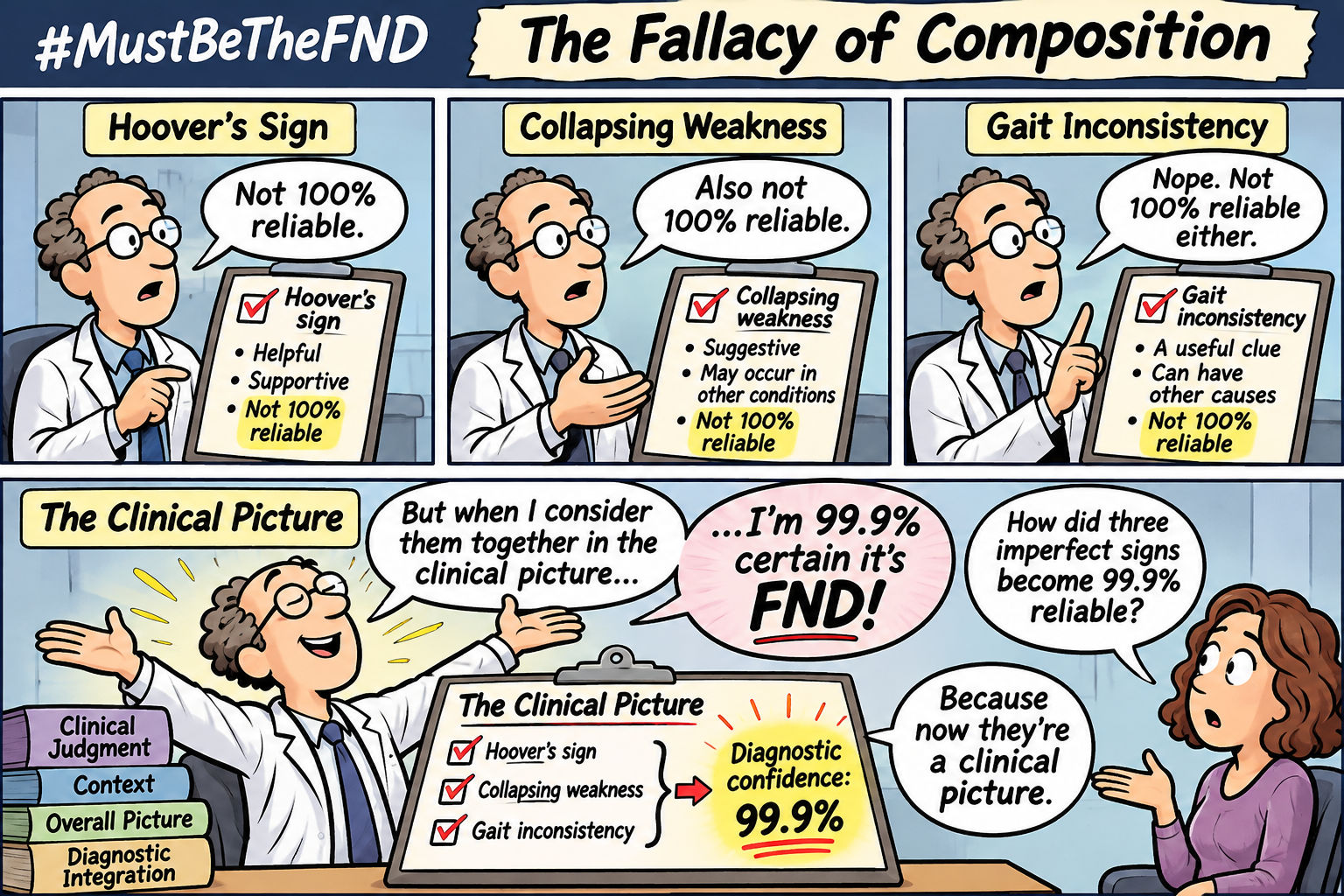
The current webpage acknowledges that none of its listed positive signs is completely reliable or should be used alone. This qualification is important because it places the burden on the combined diagnostic approach. If several imperfect signs are used together, their collective accuracy must be independently established. A combination of observations does not become diagnostically decisive merely because several are present, particularly if the same findings contributed to the original classification of patients used in validation studies.
The Risk of Diagnostic Circularity
Research into positive functional signs faces a methodological difficulty when the signs being evaluated are also used to determine which patients belong to the functional group. If Hoover's sign contributes to a patient's diagnosis and that diagnosis is subsequently used as the reference standard for measuring Hoover's sign, the evaluation risks incorporation bias. The resulting accuracy estimates may partly reflect the diagnostic process itself rather than an independent ability to distinguish causes of weakness.
The 2011 Hoover's sign study was unblinded, although the published information does not establish precisely how much the sign influenced each final diagnosis. Incorporation bias is therefore a methodological concern requiring examination, not a proven explanation for that study's results. The 2026 quantitative investigation also acknowledged difficulties associated with diagnostic circularity. Independent reference standards, blinded assessment and appropriate comparison populations are essential when researchers claim that an examination finding distinguishes one disorder from another.
Injury, Migraine and Anaesthesia: When Association Becomes Explanation
The NeuroSymptoms guide identifies several circumstances in which functional weakness may develop, including injury, severe pain, fatigue, prolonged bed rest, migraine, dissociation and recovery from anaesthesia. The 2013 factsheet contains a similar list. These circumstances may precede neurological symptoms, but temporal association does not establish the cause of those symptoms. The distinction is particularly important when the preceding event can itself produce neurological manifestations or when other medical complications remain possible.
For example, the current webpage suggests that weakness arising after anaesthesia is not caused by damage from the anaesthetic and may relate to the temporarily altered state of the brain during recovery. This explanation requires evidence rather than assumption. Postoperative weakness may warrant investigation for medication-related effects, perioperative complications or other neurological conditions. Likewise, migraine can itself produce weakness and sensory disturbances. Suggesting that migraine has triggered a separate functional disorder does not establish where the migraine-related presentation ends and the proposed functional condition begins.
The problem is not the recognition of possible triggers. It is the tendency to turn a preceding event into an explanatory narrative without demonstrating the causal relationship. A patient who develops weakness after surgery, injury or migraine needs an assessment of the actual clinical circumstances, not an assumption that the event has activated a functional disorder.
The 2013 Factsheet's Extraordinary Antidepressant Claims
The historical material contains another serious problem. On page eight, the February 2013 Chest Heart & Stroke Scotland factsheet recommends antidepressants as potentially helpful for patients with functional limb weakness, including those who are not depressed. It describes the medication as a nerve tonic that corrects chemical imbalances and assures readers that antidepressants are not addictive and will not harm them. It also suggests that taking them may improve the chances of recovery.
The unconditional assurance that antidepressants will not cause harm is indefensible. These medications have recognised adverse effects, and withdrawal can produce symptoms that are severe or prolonged in some patients. Although addiction and physical dependence are distinct concepts, that distinction does not justify dismissing the possibility of medication-related harm. The NICE guideline on depression treatment addresses antidepressant withdrawal, while the Royal College of Psychiatrists provides information on adverse effects and discontinuation.
The chemical-imbalance explanation is particularly troubling because it presents an unproven mechanism as established medical fact. Even the widely promoted serotonin-deficiency explanation for depression has not been convincingly demonstrated. Yet this factsheet goes further, suggesting that antidepressants correct chemical imbalances in patients with functional limb weakness. Which chemicals are supposedly imbalanced? How were these abnormalities measured? What evidence demonstrates that antidepressants correct them? The document provides none. Antidepressants alter neurotransmitter signalling, but changing brain chemistry is not evidence that a pre-existing chemical imbalance has been corrected. Presenting this speculation as a physiological explanation for treatment is scientifically unjustified.
This historical advice is particularly concerning in a neurological context because medication adverse effects and withdrawal can involve symptoms that overlap with neurological presentations. New or worsening weakness, tremor, dizziness and sensory disturbances require appropriate assessment, including consideration of medication exposure and recent changes. The antidepressant passage appears in the 2013 factsheet rather than the supplied current symptom webpage, so it should not be misrepresented as a quotation from the present page. Nevertheless, it documents the assurances previously given to patients in educational material adapted from Stone's work.
When Questioning the Diagnosis Becomes Health Anxiety
The 2013 factsheet encourages patients to develop confidence in their diagnosis and advises them to ask their specialist for further explanation if they remain uncertain. It also suggests that persistent concern about conditions such as stroke or multiple sclerosis may sometimes represent health anxiety, comparing such fears with an irrational fear of flying. Although the document specifies that this affects only a small proportion of patients, the comparison introduces a troubling possibility: legitimate diagnostic uncertainty may be interpreted as a psychological problem.
A patient who remains concerned about another neurological disorder may have reasons that deserve investigation, including unexplained symptoms, incomplete testing, progression or inconsistencies in the original diagnosis. Anxiety and neurological disease can coexist. The existence of worry does not establish that the concern is irrational, and confidence in a diagnosis does not make that diagnosis correct. When diagnostic doubt persists, the appropriate response is to examine the evidence and reconsider the differential where warranted, rather than treating disagreement as evidence of health anxiety.
Rehabilitation Advice Cannot Replace Diagnostic Certainty
The 2013 factsheet also recommends gradually increasing activity and reassures patients that worsening symptoms during carefully paced rehabilitation do not indicate additional damage. It describes fluctuations and relapses as expected aspects of recovery. Such statements depend on the diagnosis and rehabilitation programme being appropriate for the patient's actual condition. They cannot safely be applied without qualification to every patient presenting with weakness, particularly when the underlying cause remains uncertain.
Exercise intolerance, worsening weakness and delayed deterioration may have different explanations. Treating deterioration as an expected feature of functional recovery can become problematic if it discourages reassessment when symptoms change or fail to follow the anticipated course. Rehabilitation advice should follow an adequate clinical evaluation rather than becoming a reason to disregard subsequent evidence.
The Same Diagnostic Narrative, More Than a Decade Later
Comparing the 2013 factsheet with the current NeuroSymptoms webpage reveals substantial continuity. Both distinguish functional disturbance from neurological damage, describe positive examination findings and present variability as a key diagnostic feature. The current webpage includes additional material, including the hip abductor sign and an explicit acknowledgement that individual signs are not completely reliable. However, the central explanation remains that the observed pattern of weakness supports a disorder of nervous-system function rather than disease.
What has become increasingly difficult to ignore is the evidence that the interpretation of these signs is more complicated than such explanations suggest. Published cases document false-positive signs in neurological disease. Quantitative research demonstrates variability in the measurements underlying Hoover's sign among healthy volunteers. Studies of pain and motor learning establish that movement patterns can change in response to physical experiences, raising further questions about the possible origins of examination findings. None of these observations establishes that previous injuries routinely produce positive Hoover's signs, but together they make the assumption of a single diagnostic interpretation difficult to justify without further investigation.
The central question remains unanswered by the patient guides: when a clinician identifies an inconsistency in muscle activation, what establishes that the inconsistency is caused by the disorder currently being diagnosed? It may be a genuine and reproducible finding, but that does not establish its origin, its timing or its relationship to the patient's presenting illness. A positive sign should not become a shortcut from observation to presumed mechanism. The evidence must establish what the sign means, rather than allowing the diagnostic label to supply the explanation.
References
- NeuroSymptoms. Functional Limb Weakness. Patient information guide associated with Professor Jon Stone.
- Chest Heart & Stroke Scotland. Understanding Functional Limb Weakness. Factsheet F38, February 2013. Adapted from material by Dr Jon Stone, December 2012.
- McWhirter L, Stone J, Sandercock P, Whiteley W. (2011). Hoover's sign for the diagnosis of functional weakness: A prospective unblinded cohort study in patients with suspected stroke. Journal of Psychosomatic Research.
- Kanbayashi T, et al. (2026). Quantitative Measurement of Hoover's Sign: Development of a Standardized Sensor, Interface Procedure, and Testing in Healthy Individuals. Brain and Behavior.
- Ercoli T, Stone J. (2020). False Positive Hoover's Sign in Apraxia. Movement Disorders Clinical Practice.
- Supplementary Motor Area Stroke Mimicking Functional Disorder. (2018). Stroke.
- Motor Learning in Response to Different Experimental Pain Models Among Healthy Individuals: A Systematic Review. (2022). Frontiers in Human Neuroscience.
- Linking Pain and Motor Control: Conceptualization of Movement Deficits in Patients With Painful Conditions. (2022). Physical Therapy.
- FND Nope. (2026). The Echoes of Past Injury Hypothesis: Could FND's Positive Signs Be Remnants of Earlier Motor Adaptations?
- National Institute for Health and Care Excellence. Depression in adults: treatment and management (NG222).
- Royal College of Psychiatrists. Antidepressants.

Given that FND can be acute, transient or persistent, if functional weakness develops after an identifiable physical trigger, such as injury, pain or immobilisation, and resolves once that underlying problem is treated, how do we establish that the patient had a separate functional disorder rather than a temporary consequence of the original condition? What independent evidence distinguishes the two, particularly when recovery itself is interpreted as evidence of successful FND treatment?