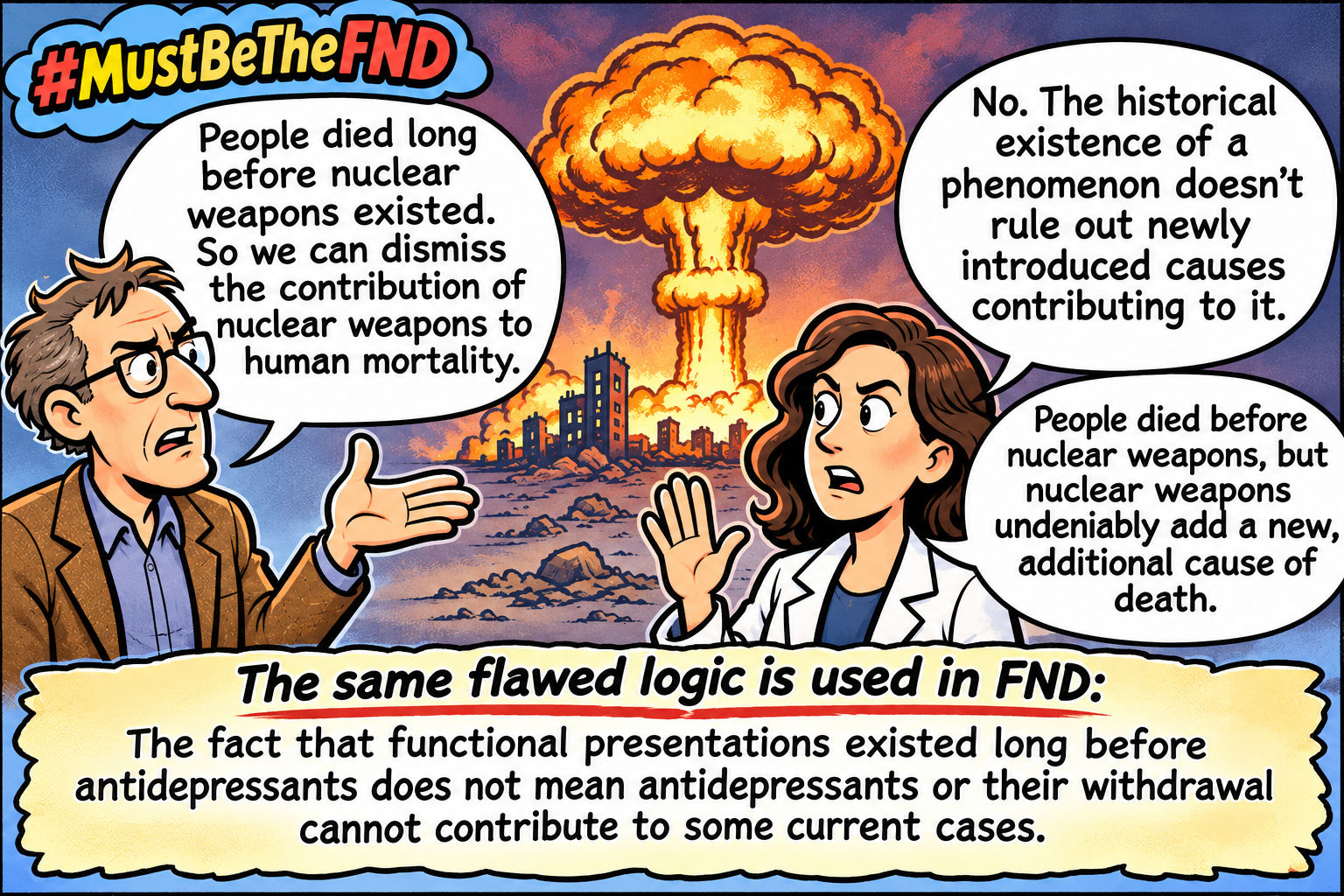
There comes a point where intellectual generosity becomes an exercise in accommodating absurdity. When a patient develops neurological disturbances shortly after taking a medication known to produce neurological disturbances, the pharmacological explanation deserves serious investigation. Apparently, however, once positive signs of Functional Neurological Disorder (FND) enter the room, pharmacology can be politely escorted out of it. The medication is demoted to a trigger, the presentation is classified as functional, and everyone can congratulate themselves on having made a positive diagnosis. How wonderfully convenient.
In our recent article, Can Medication-Induced Tremor Look Identical to Functional Tremor?, we examined a published case involving a woman who developed dystonia two hours after taking venlafaxine and subsequently developed tremor two hours after taking sertraline. The first movement disorder was attributed to medication; the second was classified as psychogenic after exhibiting distractibility, entrainment, coactivation and variability. The obvious scientific question is whether pharmacological disturbances can themselves produce these characteristics. Simply pointing at the characteristics and declaring them psychogenic is not an answer. It is the diagnostic assumption being challenged, enthusiastically repeated as though repetition constitutes validation.
People Died Before Nuclear Weapons Existed
In private correspondence with Marion Brown, dated 12 January 2017 and reproduced here with her permission, Professor Jon Stone wrote:
Functional disorders are not on the rise and have existed at roughly the same rate over time and geographical location (see attached)
They were common long before antidepressants
The attachment Jon Stone refers to in his email is reproduced below. Why he considered this paper relevant to Marion Brown's concerns about antidepressants is unclear. It neither investigates antidepressant exposure nor withdrawal, nor does it establish stable disease prevalence across historical periods.
The existence of similar neurological presentations before antidepressants were introduced does not establish that antidepressants cannot cause those presentations today. The paper simply does not address the pharmacological concerns raised.
In addition, this correspondence predates our current research and was not a response to the specific hypotheses we are now investigating. Nevertheless, the historical argument deserves scrutiny on its own merits. The existence of functional disorders before antidepressants were introduced is entirely irrelevant to whether antidepressants can produce neurological presentations subsequently attributed to FND. People died long before nuclear weapons existed. Should we therefore dismiss the contribution of nuclear weapons to human mortality? The existence of a clinical presentation before the introduction of a particular medication does not exclude that medication from subsequently producing the same presentation. This is elementary causal reasoning, not some particularly sophisticated philosophical objection requiring a doctoral thesis to comprehend.
More importantly, the historical argument completely misses the larger question explored in our Serotonergic Dysfunction Hypothesis. Medications manipulate biological processes that already exist within the human body. If artificially disturbing serotonergic regulation can produce neurological abnormalities, could disturbances in those same biological processes occur naturally and produce comparable presentations? Nobody needs to have taken an antidepressant for that research question to be valid. Insulin-induced hypoglycaemia does not require us to believe that every patient experiencing hypoglycaemia has injected insulin. Why should investigating serotonergic disturbances require an entirely different standard of reasoning? The historical existence of functional presentations does absolutely nothing to invalidate this hypothesis.
Apparently, Pharmacology Stops Where FND Begins
The same intellectual gymnastics become particularly ridiculous when discussing medication withdrawal. Withdrawal is an established pharmacological phenomenon. If a patient develops recognised withdrawal manifestations, describing withdrawal as a trigger for FND introduces an additional explanation that requires independent justification. What evidence distinguishes the direct consequences of withdrawal from the proposed functional disorder? What comparative research demonstrates that the positive signs being observed cannot arise through the pharmacological disturbance itself? Without adequately answering those questions, the word "trigger" risks becoming little more than a linguistic device for acknowledging the medication while conveniently removing its pharmacological effects from the discussion.
Are we seriously expected to accept that a medication producing its recognised adverse effects, or its discontinuation producing recognised withdrawal manifestations, becomes evidence of FND because the resulting neurological disturbance exhibits certain clinical characteristics? The drug behaves in accordance with its known pharmacology, yet the pharmacological explanation is expected to justify its existence against a diagnostic framework whose ability to distinguish these competing mechanisms is precisely what is being questioned. Apparently, pharmacology must prove its innocence, while FND enjoys the privilege of presumption.
We have already examined a case of metoclopramide-induced dystonia initially mistaken for conversion disorder, in which the patient could temporarily modify certain abnormal movements in response to instructions. Appropriate pharmacological treatment resolved her presentation. Although the report did not establish that she fulfilled modern positive FND criteria, it demonstrates why the ability to modify an abnormal movement cannot automatically invalidate a pharmacological explanation. Imagine the clinical consequences of treating such observations as permission to stop investigating.
Following my own accident in 2014, I experienced firsthand the extraordinary capacity of medications to produce bizarre neurological disturbances. Fortunately, these disturbances were not persistent in my case. That personal experience is not scientific proof of a broader hypothesis, but it certainly makes me unwilling to entertain the suggestion that pharmacological mechanisms should become secondary considerations merely because a clinician recognises a particular pattern of neurological behaviour. The capacity of medications to disturb neurological functioning should be an avenue of scientific investigation, not an inconvenience to be explained away.
Congratulations, You Found a Sign. Now Do the Science.
Recognising a clinical sign and establishing its diagnostic specificity are two entirely different accomplishments. A clinician can correctly observe distractibility while incorrectly interpreting its significance. If multiple biological mechanisms can produce comparable clinical characteristics, the clinician's confidence in recognising those characteristics does not magically confer an ability to distinguish their causes. Clinical opinion is not a substitute for comparative validation, irrespective of how many academic qualifications accompany that opinion. Being exceptionally proficient at recognising a sign whose diagnostic boundaries remain inadequately established does not resolve the inadequacy of those boundaries.
When the specificity of positive signs is challenged, withdrawing from the scientific discussion by invoking those same positive signs is unacceptable. If every medication-associated presentation exhibiting these characteristics is classified as FND, and those classifications are subsequently used to reinforce the diagnostic significance of the characteristics, how exactly is the underlying assumption supposed to be challenged? The framework risks becoming self-validating, with potentially contradictory observations conveniently absorbed into the very diagnostic category they ought to be testing. Under such reasoning, even a medication capable of directly producing the entire collection of positive signs could theoretically escape recognition because its effects would already have been classified as functional.
This is not some trivial academic disagreement over terminology. The distinction has consequences for patients, pharmacovigilance, medical research and the investigation of potentially treatable neurological disturbances. In the rush to defend the diagnostic significance of positive signs, researchers may be overlooking obvious avenues of investigation into the very presentations they claim to understand. The possibility that pharmacologically induced disturbances could provide clues to naturally occurring neurological abnormalities should be scientifically exciting. Instead, the diagnostic framework risks providing an excuse not to pursue them.
We are not obliged to accept this reasoning simply because it comes from an established academic or appears in a medical journal. Nor are we obliged to accept that a medication behaving in accordance with its recognised pharmacological effects has somehow become evidence of a separate functional disorder without adequate justification. The scientific obligation is to investigate competing explanations, establish diagnostic boundaries and demonstrate that the criteria actually distinguish what they claim to distinguish. Finding positive signs is not the completion of that work. It is where some of the most important work should begin. Anything less risks turning academic neurology into an elaborate exercise in protecting a diagnostic framework from inconvenient questions. That is not scientific rigour. That is quackademia.
If this is the standard of scientific reasoning being employed to distinguish pharmacologically induced neurological disturbances from FND, then considerably greater independent scrutiny of the diagnostic framework is urgently needed. These are not inconsequential academic shortcomings. Clinical decisions are being made, alternative explanations may be dismissed, and patients must live with the consequences. Academic authority does not exempt anyone from the obligation to substantiate their reasoning. If anything, it should demand a considerably higher standard.
Apparently, FND has neurological characteristics found nowhere else in medicine. Which ones? Excellent question. Unfortunately, instead of an answer, we've been offered a lecture about pilots, professional qualifications and AIDS denialism. Welcome aboard. Scientific evidence is apparently not included in the ticket price.
ME/CFS? Stop pacing. Long COVID? Think functional. POTS, MCAS or CCI? Perhaps FND. We examine ten controversial public statements from an FND-specialist physical therapist, the evidence behind them, and the potential consequences for patients.
Christina Applegate reveals that doctors have withdrawn her multiple sclerosis diagnosis after five years of debilitating symptoms. Her disability remains, her condition has reportedly worsened, and the search for an explanation starts again. The case raises questions about neurological misdiagnosis and the danger of replacing one incorrect diagnosis with another.